
A child may need special education for a specific academic skill, a developmental delay, a disability, communication difficulty, attention problem, or classroom participation barrier. By separating these concerns and examining how support is planned, you can identify the right assessment, teaching approach, and related services instead of relying on extra worksheets or repeated tutoring.
Key takeaways
- Assessment is needed when difficulties persist despite targeted practice.
- Plans set measurable goals for academics, communication, behaviour, and independence.
- Visual schedules, task breakdowns, and reinforcement can improve classroom participation.
- Combine special education with therapy when learning, language, sensory, or motor needs overlap.
Which learning and developmental problems can special education support?
Special education support needs are defined by what interferes with learning or participation, not by low intelligence. Reading difficulty, dyslexia, writing difficulty or dysgraphia, dyscalculia, language-based learning problems, slow academic progress, poor attention, executive-function difficulties, and autism-related needs can all qualify for targeted teaching.
Average or high intelligence does not rule out a specific learning disability; support addresses the affected skill without lowering expectations in every subject.
| Problem type | What it means | What support may address |
|---|---|---|
| Learning difficulty | Persistent difficulty with reading, writing, spelling, mathematics, or language | Explicit instruction in the weak skill |
| Developmental delay | Delay in language, thinking, movement, social-emotional, or adaptive skills | Early support before a permanent diagnosis; it does not prove future intellectual disability |
| Disability | Intellectual disability, speech and language disability, autism, or hearing or vision impairment | Individualised teaching, communication access, adapted materials, and participation |
| Behaviour concern | Avoidance, impulsivity, withdrawal, or disruption linked to confusion, attention, sensory needs, or communication | Functional assessment, replacement skills, and classroom supports |
| Temporary academic gap | A short-term lag after illness, missed teaching, or interrupted schooling | Targeted catch-up teaching and monitoring |
Motor-based classroom difficulties and problems participating in routines also fit planning. ADHD, autism, specific learning disability, and speech or language disability may be recognised under India’s Rights of Persons with Disabilities Act, 2016, but eligibility and entitlements depend on functional needs and the assessment process.
Persistent difficulty despite appropriate instruction needs assessment; one weak result does not. Families searching special education for developmental problems Pune should describe observable needs, not rely on a label alone.
What signs show that a child needs assessment rather than more practice?
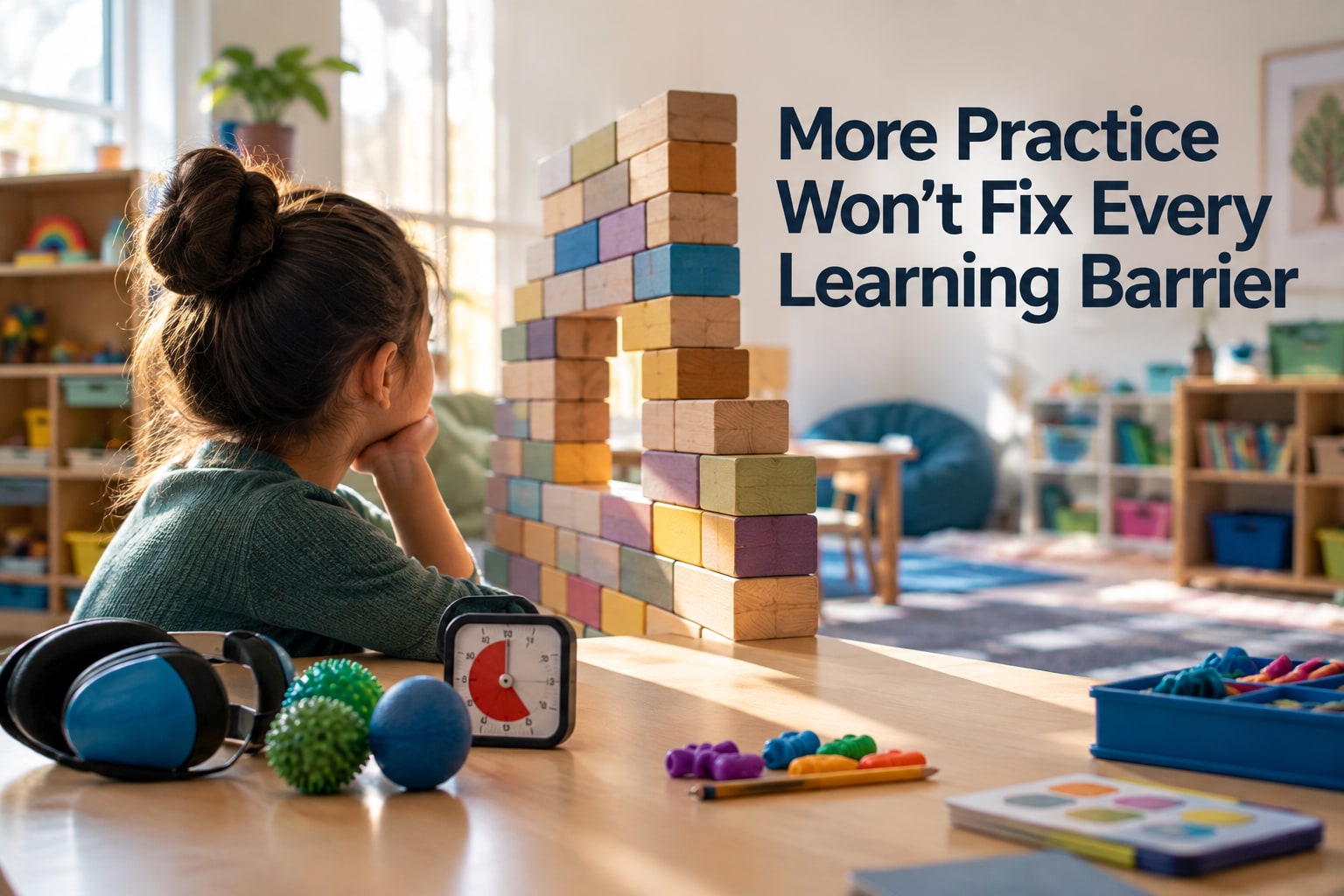
Assessment is more useful than more practice when a difficulty persists despite clear teaching and affects participation, not just one worksheet.
Warning signs include inability to follow age-appropriate classroom instructions, persistent difficulty recognising letters or numbers, unusually slow copying, trouble retaining taught material, frequent task avoidance, limited functional communication, or inability to complete daily routines independently.
One weak test result is not enough. Concern becomes stronger when the pattern continues across time, subjects, settings, or teaching methods.
- Collect developmental history, parent and teacher reports, and schoolwork samples.
- Observe the child in the classroom to see where instructions, transitions, or tasks break down.
- Test academic skills such as reading, writing, spelling, and mathematics.
- Assess communication, including understanding, expression, conversation, and functional requests.
- Use cognitive testing when the referral question requires it.
- Complete hearing and vision screening so an undetected sensory problem is not mistaken for a learning problem.
A psychologist may assess learning, cognition, or behaviour. A paediatrician may investigate developmental or medical contributors; a speech-language therapist assesses language and communication; an occupational therapist evaluates motor, sensory, and daily-function barriers; and a psychiatrist may assess attention, mood, severe behaviour, or other mental-health concerns.
Describe the support need, not only the label: “needs text-to-speech for grade-level reading” or “needs a visual schedule with a five-minute transition warning.” These functional descriptions guide special education support needs and help families comparing special education support for child problems Pune.
How is an individual special-education plan built?
After assessment, build the plan from baseline skills: what the child can do independently, with help, and not yet at all. Choose two or three measurable goals, name the teaching method, set the prompting level, identify reinforcement, assign someone to record progress, and set a review date.
- Break tasks into steps, use visual schedules, model answers, adapt worksheets, practise handwriting, apply multisensory instruction, and gradually reduce prompts.
- For reading difficulty, use explicit, systematic, cumulative teaching in phonological awareness, decoding, spelling, fluency, vocabulary, and comprehension. Extra worksheets are not specialised instruction.
- For dyscalculia, teach quantity, number sense, symbols, calculation, and problem-solving in a structured sequence.
- For language-based learning problems, target understanding instructions, vocabulary, grammar, storytelling, conversation, speech intelligibility, or augmentative and alternative communication.
- For motor-based handwriting difficulty, consider adapted writing tools, alternative response methods, positioning, and coordination with occupational therapy.
- For autism-related special education support needs, set functional goals for communication, play, flexibility, social learning, sensory regulation, self-care, transitions, and participation across home, school, and community.
A plan for special education for learning difficulties Pune should change the route to participation without lowering expectations. Review work samples and recorded data on the stated date; if progress is weak, adjust the method, prompts, goal, or reinforcement rather than adding indefinite one-to-one help.
How can special education address behaviour and classroom participation?
Behaviour, attention, and participation problems belong in special-education planning when they prevent learning, communication, safety, or independence. Task avoidance, impulsivity, refusal, disruption, or withdrawal may signal confusion, frustration, sensory overload, pain, fatigue, bullying, or an unpredictable transition.
A functional behaviour assessment examines what happens before and after the behaviour. It then identifies a replacement skill, such as requesting help, asking for a break, using a communication card, or following a visual transition plan.
- Define the target visibly: “leaves the seat three times in ten minutes” is useful; “is disruptive” is not.
- Record triggers, prevention steps, the alternative response to teach, and how adults will respond.
- Track safety, communication, learning, and participation, then review whether the plan reduces exclusion or unnecessary restraint.
- Change the plan if the child is not gaining the replacement skill.
Punishment alone does not teach what to do instead. Good special education behaviour support Pune families consider should teach communication and prevention, not compliance alone.
For attention or executive-function difficulties, use segmented tasks, clear spoken and written instructions, reduced-distraction seating, movement opportunities, checklists, time estimates, and frequent feedback. These supports do not replace an ADHD assessment or medical care when indicated.
Participation may also require captioning, sign language, hearing technology, braille, large print, tactile materials, accessible digital text, extra time, alternative answers, or direct orientation and mobility teaching. Describe special education support needs by function, not diagnosis alone.
When should special education be combined with school support or therapy?
One service is enough only when it addresses the child’s main barrier and progress appears in everyday schoolwork. Use more than one when classroom access, skill teaching, and communication, movement, sensory, or daily-function needs are different problems.
| Option | What it means | When it applies |
|---|---|---|
| Accommodation | Changes access or how the child demonstrates learning | Extra time, accessible text, reduced copying, or another way to answer |
| Specialised instruction | Teaches a missing academic or developmental skill | Structured reading, writing, mathematics, communication, or self-care teaching |
| Therapy | Targets communication, movement, sensory processing, or daily-function abilities | Speech therapy, occupational therapy, sensory integration, ABA, counselling, or medical care |
A child may need mainstream-school accommodations alongside remedial teaching, special education, speech therapy, occupational therapy, sensory integration, ABA, counselling, or medical care. Speech therapy does not replace accessible classroom teaching; occupational or sensory work does not teach reading or mathematics by itself.
Before choosing special education support for child problems Pune, special education for developmental problems Pune, or special education for learning difficulties Pune, ask whether the provider:
- Completes a baseline assessment and writes measurable individual goals.
- Coordinates with the school and other therapists.
- Reviews work samples or recorded data on a stated date.
- Teaches skills that transfer to home, school, and community.
- Avoids indefinite one-to-one assistance and age-inappropriate worksheets.
SAVI CHILD DEVELOPMENT AND RESEARCH CENTRE PVT LTD is worth considering only when its multidisciplinary assessment and planning match those functional goals and records progress transparently.
Related services
Special Education provides personalized learning and developmental support for children with different learning needs and abilities. View service → |
Neuro Development focuses on supporting a child’s overall growth by strengthening cognitive, motor, communication, social, and emotional skills. View service → |
Frequently asked questions
Which learning and developmental problems can special education support?
It can support dyslexia, dysgraphia, dyscalculia, language-based learning problems, slow academic progress, attention and executive-function difficulties, autism-related needs, and other barriers to learning or participation.
What signs show that a child needs assessment rather than more practice?
Request an assessment when a difficulty persists despite structured practice, affects classroom participation, appears across settings, or causes a widening gap between the child and expected skills.
How is an individual special-education plan built?
The process reviews the child’s current academic, communication, behaviour, and daily-living skills, then sets specific measurable goals, teaching methods, accommodations, review dates, and progress measures.
How can special education address behaviour and classroom participation?
A plan identifies triggers and the purpose of behaviour, then teaches replacement skills using routines, visual supports, task breakdowns, reinforcement, communication supports, and planned responses.
When should special education be combined with school support or therapy?
Combine services when the child needs coordinated help across settings, such as special education for academic skills alongside speech therapy, occupational therapy, behavioural support, or classroom accommodations.
Related services
Sensory Integration The early years of childhood are a crucial period for learning and development. View service → |
Speech Therapy At Savi ChildCare, our specialized Speech Therapy services help children develop effective communication and language skills in a supportive,... View service → |
Early Intervention . Early Intervention Centre Services Can Make a Meaningful Difference The early years of childhood are a crucial period for learning and development. View service → |
ABA Therapy Applied Behavior Analysis (ABA) Therapy is a personalized approach that helps children develop important communication, social, learning, and... View service → |