

A child may struggle with speech, chewing, drooling or food textures for very different reasons, and an autism or developmental-delay diagnosis does not automatically make oral placement therapy appropriate. By the end, you will be able to match the child’s signs to the right assessment, distinguish oral placement work from related therapies, and ask a Pune provider how progress and safety will be measured.
Key takeaways
- Choose therapy for a functional difficulty, not an autism diagnosis alone.
- Ask how oral placement goals connect to speech, eating, drinking, or saliva control.
- Request baseline measures and a date for reviewing progress.
- Treat pain, unsafe swallowing, or hearing loss before oral placement therapy.
Which children may benefit from oral placement therapy?
Suitability depends on a functional difficulty, not on a diagnosis. Children may benefit when limited lip or tongue movement, weak jaw stability, poor breath control, or difficulty coordinating oral movements affects speech, eating, drinking, or saliva control. Autism alone does not show that oral placement therapy is needed.
The question “who benefits from oral placement therapy children pune” should lead to an assessment, not a diagnosis-based assumption.
Signs that justify assessment include:
- Speech that remains difficult to understand, especially when motor-planning or oral-motor control appears involved
- Persistent open-mouth posture, drooling, or difficulty closing the lips
- Prolonged chewing, coughing or choking during meals, or refusal of textures
- Difficulty imitating tongue, lip or jaw movements
- Trouble moving the tongue and lips independently for speech or feeding
| Sign | Functional goal to investigate | Useful baseline |
|---|---|---|
| Hard-to-understand speech | Target sounds, syllables or intelligibility | Intelligibility and sound accuracy |
| Drooling or open-mouth posture | Lip closure and saliva control | Drooling frequency |
| Slow chewing or texture refusal | Safer, more efficient eating | Meal duration and foods accepted |
| Little reliable speech | Access to functional communication | Gestures, signs, pictures or device use |
The therapist should explain how a tactile or movement cue will transfer to a sound, word, meal skill, or communication act. Holding a tongue position without better intelligibility or eating function is not enough.
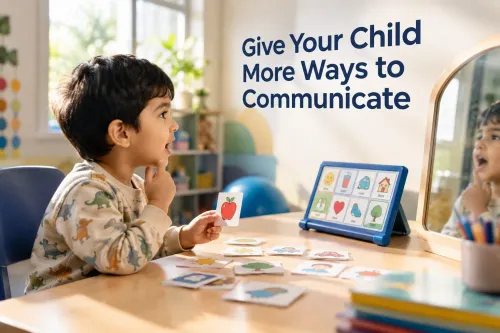
Oral placement therapy for communication difficulties should not delay augmentative and alternative communication when a child needs a reliable way to express choices, needs, and ideas.
How does oral placement work compare with other therapies?
Choose oral placement work for a specific movement problem, not as a replacement for every communication or developmental therapy.
| Option | Main target | When it applies |
|---|---|---|
| Oral placement therapy | Jaw, lip, tongue, and breath control | Limited oral movement, weak jaw stability, drooling, chewing difficulty, or a speech movement that does not emerge |
| Speech-language therapy | Speech sounds, language, comprehension, vocabulary, grammar, and conversation | Unclear speech, sound errors, delayed language, or difficulty communicating |
| Occupational therapy | Self-care, fine-motor skills, posture, and daily participation | Dressing, writing, sitting, hand use, or routine independence is affected |
| Sensory integration | Responses to sensory input and regulation during activities | Noise, touch, movement, or body-awareness differences disrupt participation |
| Feeding therapy | Safe, efficient eating and food acceptance | Coughing, choking, prolonged meals, texture refusal, or restricted foods |
| ABA | Observable skills, routines, learning, and behaviour support | The child needs structured teaching for communication, independence, or participation |
Speech-language therapy remains central when the problem involves language or predictable speech-sound errors. Oral placement support for speech is an adjunct only when the clinician can connect a mouth movement to a target sound, syllable, word, or intelligibility gain. Better tongue positioning alone is not enough.
Combining services makes sense when goals overlap without duplicating exercises: feeding therapy for safe swallowing, occupational therapy for posture or self-care, and speech-language therapy for communication. Ask how each clinician will measure progress. Oral placement therapy for communication difficulties should produce functional communication gains, not just improved performance during isolated exercises.
What happens during assessment, treatment and progress review?
A clinician begins by watching function, not just mouth movements: lip closure, jaw stability, tongue movement, saliva control, chewing, food textures, breath coordination, imitation and speech intelligibility. They also note coughing, fatigue, open-mouth posture and whether the child can move the jaw, lips and tongue independently. A diagnosis alone does not select the treatment.
| Stage | What the clinician does | What is measured |
|---|---|---|
| Assessment | Observes eating, drinking, oral movements and speech; records relevant medical, hearing and language information | Baseline for chewing, drooling, accepted textures, intelligibility or communication access |
| Treatment | Chooses one functional target and uses visual, verbal or tactile-kinesthetic cues with repeated movement practice | Whether the child performs the target with less help and greater consistency |
| Progress review | Compares new observations with the baseline within an agreed review period | Change in everyday performance, not just an isolated exercise |
Goals might include closing the lips around a cup, chewing a safer texture, reducing drooling or producing a specific speech movement. Cues should be faded as control improves; blowing, sucking or strengthening drills should not replace speech practice targeting the child’s actual errors.
Oral placement support for speech is an adjunct when a movement barrier is identified, not a promise to make an autistic child speak.
Useful oral motor therapy benefits children only when they appear in daily life: clearer understandable speech, safer swallowing, shorter meals, more accepted foods, better saliva control or greater access to functional communication. If these outcomes do not improve, the clinician should reassess the goal, method or referral plan.
When is oral placement therapy the wrong first step?
Coughing, choking, wet-sounding breathing, weight loss, painful meals or recurrent chest infections make oral placement therapy the wrong first step. Ask a paediatrician and a speech-language pathologist trained in swallowing to assess safety before exercises begin.
A restricted diet can also reflect reflux, constipation, dental pain, sensory aversion or feeding behaviour, not simply weak oral movement.
1. Check structure and hearing first. An ENT specialist, dentist or orthodontist can assess nasal obstruction, enlarged tonsils, tongue-tie, jaw or palate differences; an audiologist can test hearing. Undetected hearing loss can make speech sound unclear without an oral-movement problem.
2. Request a motor-speech assessment for suspected childhood apraxia of speech. CAS affects planning and programming speech movements, so speech-target practice with systematic cueing and cue fading matters more than isolated mouth exercises.
3. Choose speech-language therapy when predictable sound errors, limited vocabulary, grammar, comprehension or conversation drive the difficulty. Oral placement therapy for communication difficulties should not replace language therapy, speech-sound practice or AAC when the child needs a communication system.
4. Do not copy home exercises from videos or use force, bite blocks or tools without instruction. Incorrect pressure can cause distress, fatigue, gagging or unsafe swallowing; judge progress by intelligibility, accepted foods, meal duration or choking frequency, not exercise performance.
For oral placement therapy for children in Pune, ask for a qualified clinician’s assessment, baseline measures and referral plan. Verify Rehabilitation Council of India registration where applicable, then review progress with the relevant medical, hearing, feeding, motor-speech or AAC professional.
How should Pune families choose and question a provider?
A search for “who benefits from oral placement therapy children pune” should lead to an assessment, not a promise. Choose a speech-language professional who examines speech, feeding, hearing and oral-motor function, and verify Rehabilitation Council of India registration where applicable. Registration is a safeguard, not proof that every oral-placement method suits your child.
Ask the provider for:
- The clinician’s qualification, RCI registration number, experience with your child’s age and presenting difficulty, and the professional they refer to for hearing, swallowing, dental or medical concerns.
- Baseline measures: accepted foods, meal duration, coughing or choking frequency, drooling, speech intelligibility, target sounds, language use and functional communication.
- A review date, such as 6–12 weeks, with goals tied to eating safety, food variety, intelligibility or communication—not attendance or improved performance on an isolated mouth exercise.
- A clear explanation of how each cue transfers to a sound, syllable, word or mealtime skill. Blowing, sucking or strengthening drills must not replace speech practice for predictable sound errors.
Check the difference between a useful plan and a warning sign:
| Provider answer | What it shows | Your response |
|---|---|---|
| Specific baseline and review date | Progress can be tested | Proceed to compare results |
| “Your child will speak” or “this cures autism” | Unsupported promise | Seek another opinion |
| Referral to audiology or medical care | Limits are recognised | Complete the referral |
| No link between exercise and function | Transfer is unclear | Ask for a measurable rationale |
SAVI CHILD DEVELOPMENT AND RESEARCH CENTRE PVT LTD may fit a broader plan when its assessment connects oral-placement work with speech-language, occupational, sensory or early-intervention referrals. For oral placement therapy for children pune families, judge the plan by functional change, not the exercise list.
Related service
Oral Placement Therapy (OPT) focuses on improving the awareness, strength, coordination, and movement of the muscles involved in speech, feeding, and oral motor... View service → |
Frequently asked questions
Which children may benefit from oral placement therapy?
Children may benefit when limited lip or tongue movement, weak jaw stability, poor breath control, or poorly coordinated oral movements affect speech, eating, drinking, or saliva control. Autism alone does not establish a need for this therapy.
How does oral placement therapy compare with other therapies?
Oral placement work targets the movement and stability of the lips, tongue, jaw, and related oral functions. Speech-language therapy addresses communication and speech directly, while feeding therapy focuses on safe, effective eating and drinking. A provider should explain why oral placement is needed alongside, or before, those approaches.
What happens during assessment and progress review?
The clinician should examine oral movements and connect findings to a functional concern such as intelligibility, chewing, drinking, or saliva control. Treatment should begin with measurable goals, documented baseline observations, and scheduled progress reviews.
When is oral placement therapy the wrong first step?
It is not the first step when the main concern involves pain, unsafe swallowing, significant hearing difficulty, breathing problems, or another medical issue requiring evaluation. Address that concern first and coordinate therapy with the appropriate clinician.
How should Pune families choose and question a provider?
Ask about the clinician’s qualifications, assessment process, proposed goals, home practice, expected review date, and how progress will be measured. Choose a provider who explains the functional reason for therapy and welcomes questions about alternatives.