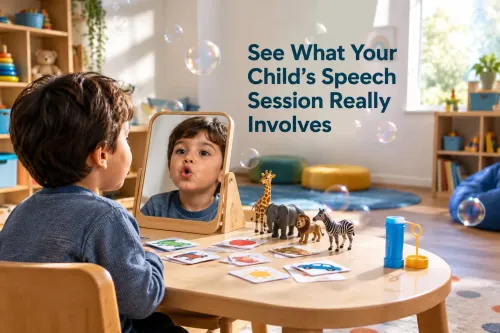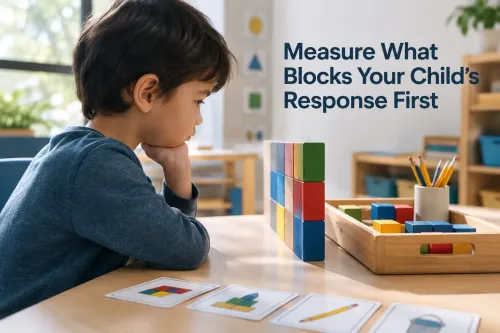

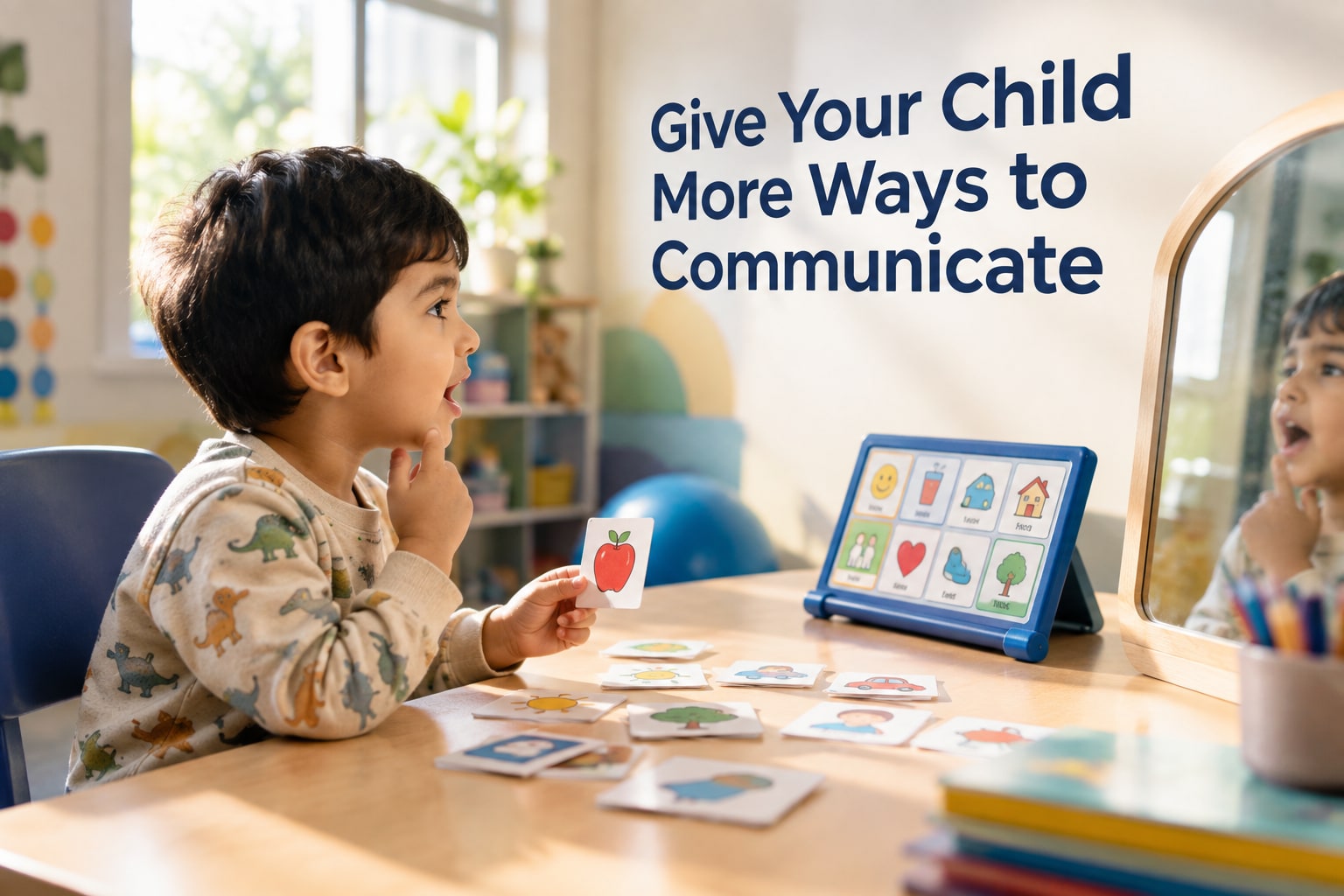
A child who is hard to understand, uses few words, stops using words, or relies on gestures and behaviour to communicate needs a careful communication assessment—not automatic pronunciation drills or a decision to wait. By the end, you will know which signs warrant referral, what the first assessment examines, how therapy goals are measured, and when speech therapy should be coordinated with other support.
Key takeaways
- Arrange assessment for unclear speech, few words, stammering, echolalia, or difficulty following instructions.
- Choose goals linked to daily needs, such as requesting, answering, greeting, or following directions.
- Nonverbal children can communicate through gestures, signs, picture cards, or speech-generating devices.
- Ask providers how therapists, special educators, and families will coordinate support in Wanowrie.
Which communication difficulties warrant a speech-language assessment?
Arrange a speech-language assessment rather than waiting when your child is hard to understand, uses few words, struggles to follow instructions, stammers, has voice changes, repeats phrases through echolalia, or finds social communication difficult. Frequent frustration, no meaningful babbling or gestures, and difficulty responding to sound or speech also justify prompt review.
| Sign or pattern | What to arrange | Why it matters |
|---|---|---|
| Unclear speech, limited vocabulary, echolalia, or social-communication difficulty | Speech-language assessment | Identifies speech, language, play, and interaction needs |
| Stammering or voice change | Speech-language assessment | Examines fluency, vocal use, distress, and participation |
| No meaningful babbling or gestures, or poor response to sound | Speech-language and hearing evaluation | Hearing loss can affect speech and language development |
| Lost words or other acquired skills | Speech-language, developmental, and hearing evaluations | Skill loss needs broader investigation, not “wait and see” |
| Cannot follow age-expected instructions or shows wider developmental concerns | Speech-language and developmental evaluation | Communication may overlap with learning, motor, sensory, or developmental needs |
For speech therapy for communication delays wanowrie, choose broad assessment over pronunciation drills alone. If speech becomes unclear, repeated correction can miss hearing loss, structural differences, motor-planning difficulty, or language impairment. Children who stutter need patient listening: do not command them to slow down, repeat, or finish words.
A bilingual or multilingual child must be assessed across every regularly used language. Using more than one language does not cause a disorder; a genuine difficulty affects communication across languages, although vocabulary differs by exposure.
For families searching speech therapy benefits for children who struggle to communicate wanowrie, early assessment can clarify the next step without relying on rigid milestone diagnosis.
What the first assessment examines—and how it differs from other services
A first assessment is not a pronunciation test. It identifies why communication is difficult and how the child communicates in real life.
- The clinician interviews you about concerns, strengths, languages used, routines, and priorities.
- They review developmental and case history, including milestones, medical conditions, regression, schooling, and previous intervention.
- They check hearing status and refer for a hearing evaluation when testing is missing, outdated, or concerning.
- They examine oral-motor function, including movement and coordination of the lips, tongue, jaw, and face.
- They observe play, social interaction, attention, gestures, imitation, and responses to communication.
- They collect a language sample covering understanding, expressive language, speech sounds, fluency, voice, and functional communication.
- They compare communication across home, school, and community settings, because performance in a clinic may not represent daily needs.
Speech therapy for communication delays in Wanowrie focuses on communication itself. A general developmental assessment considers broader development; occupational therapy addresses sensory processing, motor skills, and daily living; ABA therapy often targets behaviour and learning; special education supports curriculum access; oral placement therapy addresses assessed feeding or motor needs, not speech universally.
One service may be sufficient when the difficulty is specific. A coordinated plan is more useful when communication overlaps with learning, sensory, motor, behaviour, or developmental needs.
Do not treat blowing or tongue strengthening as universal speech treatment. Before repeated pronunciation correction, rule out hearing loss, structural differences, motor-planning difficulties, and broader language impairment.
How measurable goals turn therapy into useful daily communication
Therapy becomes useful when assessment findings and family priorities become observable daily targets, not a vague promise to “improve speech.” A clinician records what the child will communicate, with whom, where, and how often.
- Choose a functional purpose, such as requesting a preferred toy, rejecting an activity, or communicating pain, hunger, or the need to use the toilet.
- Define understanding and interaction goals, such as following a two-step instruction, answering “who” or “what” questions, taking two conversational turns, or sharing attention during play.
- Set speech targets that can be counted, such as producing a target sound in words with a specified level of accuracy.
- Review progress across people and settings, including home, school preparation, meals, dressing, play, and community routines.
Activities may include picture exchange, gestures, sign-supported communication, play routines, story activities, sound practice, and turn-taking games. A child who uses few spoken words can work on reliable communication immediately rather than waiting for speech to emerge.
Success means communicating more often, being understood by familiar and unfamiliar listeners, joining play and school routines, and experiencing less frustration—not only scoring higher on a test.
For autism-related communication difficulties, child speech therapy support in Wanowrie should practise requesting, turn-taking, shared attention, and caregiver interaction during natural play, not rely only on table-based naming or repetition.
How speech therapy supports nonverbal children and children who use other forms of communication
A child who is not yet speaking is still communicating through gestures, vocal sounds, eye gaze, pointing, leading an adult by the hand, behaviour, pictures, signs, a communication book, a communication board, or a speech-generating device.
Speech therapy for nonverbal children in Wanowrie can build reliable ways to request, choose, refuse, comment, share attention, interact socially, and report pain while speech development is assessed and supported when appropriate.
Speech production and communication are related but different goals. AAC provides an immediate communication route instead of making a child wait for spoken words.
| Speech production | Communication |
|---|---|
| Producing sounds, words, or sentences | Expressing needs, choices, feelings, ideas, and social messages |
| Practising speech sounds or motor planning | Using gestures, symbols, signs, pictures, or devices |
| Being understood by listeners | Requesting, refusing, commenting, sharing attention, and reporting pain |
AAC does not prevent speech or mean the child has stopped progressing. Symbols can reduce frustration and give repeated opportunities to connect words with meanings, so do not abandon AAC when spoken words begin.
Caregiver coaching makes child speech therapy support in Wanowrie more useful between sessions:
- Model the child’s communication system instead of demanding imitation.
- Offer two clear choices and pause for a response.
- Honour rejection, including turning away or pushing an item aside.
- Practise during meals, dressing, play, travel, and bedtime.
Therapy frequency cannot be prescribed from age or diagnosis alone. It depends on hearing, cognitive and motor abilities, attention, communication profile, family priorities, and opportunities to practise.
How to choose coordinated child speech-therapy support in Wanowrie
Choose a provider that assesses the whole communication profile, not one that begins with pronunciation drills. Ask whether the clinician will examine:
- Receptive and expressive language, speech sounds, fluency, voice, hearing status, oral-motor function, play, social communication, and AAC.
- Communication across home, school, and community, with a language sample and play-based observation.
- Goals recorded in observable terms, such as requesting a toy, following a two-step instruction, answering “who” or “what,” taking two turns, or reporting pain and toileting needs.
- How caregivers and school staff will practise the goals, and when progress will be formally reviewed.
| Isolated support | Coordinated support | When it applies |
|---|---|---|
| Pronunciation practice only | Speech-language assessment plus functional goals | Use coordination when language, hearing, play, or social communication is also affected |
| One therapist’s notes | Shared updates with family, school, and other clinicians | Useful when learning, sensory, motor, behaviour, or developmental needs overlap |
| Spoken words as the only outcome | Speech, gestures, signs, pictures, or AAC | Appropriate when a child is nonverbal or needs a reliable way to request, refuse, comment, or report pain |
A child may need speech therapy alongside special education, occupational therapy, psychology, developmental paediatrics, or ABA. Compare evaluation details, family coaching, hearing referrals, AAC access, and school communication before choosing child speech therapy support in Wanowrie.
SAVI CHILD DEVELOPMENT AND RESEARCH CENTRE PVT LTD may suit families seeking this coordination rather than isolated sessions. Judge speech therapy benefits for children who struggle to communicate in Wanowrie by asking: Is the child initiating more, communicating across people and settings, participating with less frustration, and being understood more reliably?
Related services
Speech Therapy At Savi ChildCare, our specialized Speech Therapy services help children develop effective communication and language skills in a supportive,... View service → |
Oral Placement Therapy (OPT) focuses on improving the awareness, strength, coordination, and movement of the muscles involved in speech, feeding, and oral motor... View service → |
Frequently asked questions
Which communication difficulties warrant a speech-language assessment?
Arrange an assessment when your child is hard to understand, uses few words, struggles to follow instructions, stammers, has voice changes, repeats phrases through echolalia, or finds social communication difficult. Frequent frustration, limited babbling or gestures, and difficulty responding to sound or speech also warrant prompt review.
What does a child speech-language assessment examine?
The assessment examines speech sounds, understanding, spoken expression, social communication, fluency, voice, oral-motor skills, play, gestures, and alternative communication needs. It differs from general developmental care because it focuses specifically on communication and related feeding or oral-motor functions.
How do measurable speech therapy goals help children communicate?
Measurable goals connect therapy to daily actions, such as requesting an item, answering a question, following a two-step instruction, greeting someone, or producing a target sound. Progress can then be tracked across therapy sessions and home or school routines.
How does speech therapy support nonverbal children?
Speech therapy can build communication without requiring speech first. A child may use gestures, signs, picture cards, communication boards, or a speech-generating device while therapists continue supporting understanding, interaction, and any emerging spoken language.
How do I choose coordinated child speech-therapy support in Wanowrie?
Ask how the provider assesses communication, records baseline skills, sets measurable goals, shares home practice, and coordinates with occupational therapists, physiotherapists, special educators, and school staff when needed.
Related service
Early Intervention . Early Intervention Centre Services Can Make a Meaningful Difference The early years of childhood are a crucial period for learning and development. View service → |