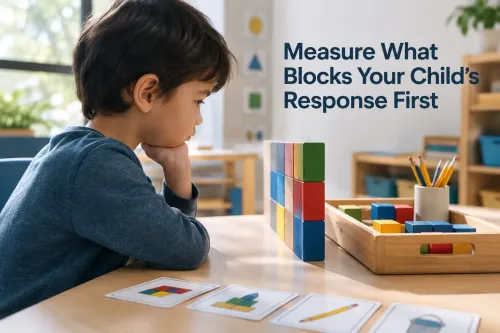


A child speech therapy visit is more than repeating sounds at a table: the therapist gathers information, watches how the child communicates, builds targeted practice into play, and records what happens. By the end, you will know what to expect at a first appointment, how treatment activities are selected, what caregivers do, and how progress shapes the next session.
Key takeaways
- The first appointment usually evaluates communication rather than delivering a full treatment session.
- Therapists assess understanding, speech, play, gestures, turn-taking, and social responses.
- Sessions combine play, targeted practice, feedback, and activities matched to the child’s goals.
- Caregivers support progress by practising short, specific activities between visits.
What Happens at a First Speech Therapy Appointment
A first speech therapy appointment is usually an evaluation, not a regular treatment session. At a first speech therapy appointment, child participation matters as much as caregiver answers: the therapist watches how the child understands, communicates, plays, takes turns, and responds to unfamiliar people.
The child may warm up slowly; that does not make the visit unsuccessful.
The therapist will ask about:
- Pregnancy, birth, medical history, hearing, development, and family history
- Early sounds, words, gestures, sentences, and any loss of skills
- What the child understands, says, and communicates through behaviour
- Speech clarity, stuttering, voice, social interaction, feeding, and oral-motor concerns
- Communication at home, childcare, or school, including languages used
- Your main concerns and the situations in which communication breaks down
The child may complete age-appropriate tasks with pictures, objects, books, songs, pretend play, or conversation. For a young child, play is often the assessment itself. The therapist may take a language sample, listen to speech sounds, and refer for a formal audiology evaluation if hearing information is missing or uncertain.
Caregivers participate throughout, not only during the closing discussion. The therapist may demonstrate ways to create communication opportunities during meals, dressing, reading, or play. If speech does not meet the child’s needs, gestures, pictures, a communication book, or a speech-generating device may be discussed.
The visit ends with findings, recommended goals or referrals, home strategies, and a plan for what happens in a child speech therapy session next.
How the Therapist Identifies the Communication Difficulty
The therapist separates the concern by examining what the child understands, communicates, says, and does during play and conversation—not pronunciation alone. During a first speech therapy appointment, the child may complete age-appropriate tasks, share a language sample, follow directions, and interact with the caregiver.
| Area | What the therapist looks for | What it may indicate |
|---|---|---|
| Speech sounds | Repeatedly replacing, omitting, or distorting particular sounds, even when the child understands and uses sentences | Speech sound problem |
| Language | Limited vocabulary, short sentences, difficulty telling or answering about events | Expressive language delay |
| Understanding | Trouble following directions, identifying objects, answering questions, or grasping concepts | Receptive language difficulty |
| Fluency | Repetitions, prolongations, blocks, tension, or avoidance while speaking | Stuttering concern |
| Voice | Persistent hoarseness, breathiness, unusual pitch, loudness, or vocal fatigue | Voice concern |
| Social communication | Difficulty taking turns, sharing attention, reading cues, adapting language, or using gestures appropriately | Social-communication difference |
| Feeding or oral motor | Coughing or choking with food, prolonged meals, restricted textures, drooling, chewing difficulty, or unusual lip, tongue, jaw, or palate movement | Feeding or oral-motor concern |
The therapist may perform an oral-mechanism examination and recommend a hearing evaluation because mild or fluctuating hearing loss can affect speech and language. For a multilingual child, assessment considers every language and opportunities to use each; limited exposure to the testing language is not itself a disorder.
If speech does not meet the child’s needs, gestures, pictures, communication books, or a speech-generating device can support communication without preventing speech development.
The Usual Sequence of a Child Speech Therapy Session
A session usually follows a predictable arc, but the timing changes with the child’s age, goals, attention, fatigue, and regulation. The first visit may focus on evaluation rather than treatment, while later visits use the speech therapy session steps below.
1. Greeting and settling in: The therapist welcomes the child, checks energy and comfort, and lets them explore the room or choose a familiar activity.
2. Caregiver check-in: You share changes since the last visit, such as new words, unclear sounds, difficulty understanding instructions, stuttering, illness, or successful home practice.
3. Goal review: The therapist names the day’s target, such as requesting with words, producing a sound, following directions, taking conversational turns, or using pictures or a speech-generating device.
4. Warm-up and modelling: Through play, books, conversation, or movement, the therapist demonstrates the target and creates reasons for the child to communicate.
5. Guided practice: The child tries the skill with prompts, choices, repetition, and feedback. The therapist adjusts the task if the child becomes tired, overwhelmed, or frustrated.
6. Observation and data collection: The therapist records responses, accuracy, prompts, communication attempts, and strategies that helped. One difficult session does not define progress.
7. Caregiver coaching and close: You practise one or two techniques for routines such as meals, dressing, reading, or play. The therapist explains what happened in a child speech therapy session, assigns manageable home practice, and agrees on the next target or referral, including a hearing assessment when needed.
Speech Therapy Activities for Children and How They Change
An activity earns its place by targeting a communication skill, not by keeping a child busy. A therapist might turn a toy routine into practice for requesting, joint attention, vocabulary, or turn-taking, then record whether the child communicated independently or needed prompting.
| Activity | Main target | How it changes |
|---|---|---|
| Play routines and pretend play | Requests, gestures, vocabulary, social communication | Use simple cause-and-effect toys for toddlers; add pretend sequences, choices, and conversation for older children. |
| Picture books and story cards | Understanding, describing, answering questions, storytelling | Ask pointing questions for early communicators; use “why,” prediction, grammar, and retelling tasks for advanced speakers. |
| Sound games and word practice | Speech-sound accuracy | Practise one sound in play for a young child; move from single words to sentences and conversation for an older child. |
| Songs, rhythm, and turn-taking | Attention, imitation, fluency, and interaction | Keep turns brief with frequent movement; increase waiting time and conversational rules as attention grows. |
| Pictures, gestures, or an AAC device | Functional communication when speech is insufficient | Start with requesting or rejecting; expand to commenting, answering, combining symbols, and communicating across settings. |
A child with stuttering needs relaxed turn-taking and fluency-supportive conversation, not pressure to repeat words. A child with a language delay needs vocabulary or sentence targets, while a child with a speech-sound disorder needs carefully chosen sounds and practice levels.
For feeding or oral-motor concerns, the therapist uses relevant eating, chewing, or swallowing tasks rather than generic mouth exercises. Shorter turns, visual schedules, movement breaks, and preferred toys help when attention is limited.
How Progress Is Measured and What Caregivers Do Between Visits
A useful goal names the behaviour and the condition: “produce /k/ in 8 of 10 attempts with one prompt,” or “follow two-step directions during play.” The therapist records correct responses, communication attempts, vocabulary or grammar targets, and the level of prompting, then compares results across visits and settings.
One difficult session does not erase progress; illness, fatigue, anxiety, sensory regulation, or unfamiliarity can affect performance.
The speech therapy session steps often end with a caregiver review: which speech therapy activities for children worked, what to practise during meals, dressing, reading, or play, and how many short opportunities to create before the next appointment. The therapist changes a goal when data show mastery, excessive difficulty, or poor usefulness in daily life.
Ask for a referral when hearing, feeding, oral-motor, developmental, psychological, or educational concerns fall outside the therapist’s scope. SAVI CHILD DEVELOPMENT AND RESEARCH CENTRE PVT LTD is worth comparing on whether its assessment and referral process is explained in writing, not only on the list of services.
Ask every provider:
- What exact measure will you record, and how often will you share it?
- What does home practice look like, and how will you adapt it if my child refuses?
- How do you assess children who use more than one language?
- Which signs trigger a hearing test or referral to another professional?
- Who attends feedback, and how is the next appointment chosen?
- What happens if progress stalls, and when will goals be reviewed?
Related service
Speech Therapy At Savi ChildCare, our specialized Speech Therapy services help children develop effective communication and language skills in a supportive,... View service → |
Frequently asked questions
What happens at a first speech therapy appointment for a child?
The therapist asks caregivers about development and communication, then observes the child’s understanding, speech, play, gestures, turn-taking, and response to unfamiliar people.
How does a therapist identify a child’s communication difficulty?
The therapist combines caregiver history, direct observation, play-based tasks, communication samples, and formal or informal assessment results.
What are the usual steps in a child speech therapy session?
A session usually includes a check-in, warm-up, targeted activities, practice with feedback, and guidance for activities between visits.
Which speech therapy activities are used for children?
Activities can include play-based turn-taking, following directions, naming, sound practice, requesting, storytelling, conversation, and communication-support exercises.
How is a child’s speech therapy progress measured?
The therapist tracks specific goals such as accurate sounds, new words, following directions, communication attempts, participation, and performance across settings.