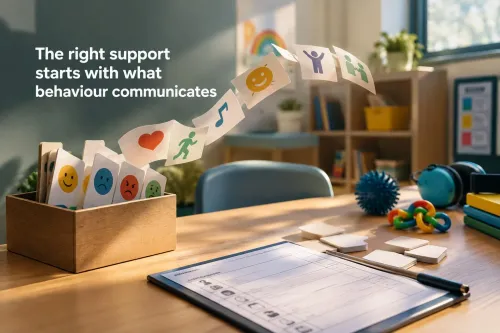


Aggression, refusal, anxiety, self-injury, or classroom avoidance can have very different causes, so choosing between ABA and counselling starts with identifying what the behaviour communicates or achieves. By the end, you will know how the two approaches differ, when another therapy belongs in the plan, and which questions to ask Pune providers before enrolling your child.
Key takeaways
- ABA analyses behaviour patterns; counselling addresses emotions, coping, and relationships.
- Ask what function the behaviour serves before selecting a therapy plan.
- Request clear goals, progress measures, consent procedures, and caregiver involvement.
- Seek another assessment when behaviour changes suddenly or risks safety.
How do ABA and counselling differ for a child in a special school?
ABA and counselling differ in the question they answer: ABA asks what behaviour is happening, what precedes it, what follows it, and what function it serves; counselling asks what the child is feeling and how the child can cope.
| Aspect | ABA | Counselling |
|---|---|---|
| Purpose | Teach observable skills and change environmental contingencies | Support emotions, coping, anxiety, grief, self-esteem, family stress, and regulation |
| Practitioner role | Measures behaviour, identifies its function, and designs teaching and reinforcement | Builds emotional safety, explores experiences, and teaches coping strategies |
| Methods | Antecedent and consequence analysis, prompting, reinforcement, visual supports, and replacement skills | Talk-based, play-based, visual, parent-mediated, or communication-supported approaches |
| Session structure | A planned teaching sequence with targets, practice, data collection, and review | A flexible session shaped by the child’s communication, emotional state, and goals |
| Outcomes | Requesting help, waiting, transitioning, participating, and completing tasks more independently | Better emotional expression, anxiety management, coping, self-esteem, and regulation |
Counselling is not automatically standard talk therapy. For anxiety, CBT requires adaptation to the child’s developmental, cognitive, and communication level; some children need pictures, play, caregivers, or augmentative communication instead.
ABA therapy versus counselling for children is not a contest. ABA is more directly suited to measurable teaching and environmental change, while counselling is better suited to emotional experience and coping.
Families searching for ABA therapy or counselling for special school behaviour therapy Pune options should know that some children need both, with shared goals and consistent support across classroom, home, and therapy settings.
What does ABA therapy for child behaviour actually involve?
A credible ABA therapy for child behaviour starts with one observable target, not a label such as “stubborn.” The family should receive functional goals, a teaching procedure, reinforcement plan, responsible adults, and a review date.
1. Define the target: “hits another person during a demand,” “leaves the classroom,” or “does not begin a task within two minutes.” Record baseline frequency, duration, latency, or completed steps before changing the plan.
2. Record what happens before and after the behaviour. Note demands, noise, denied objects, attention, pain signs, and consequences. Complete a functional behaviour assessment when risk, persistence, or complexity warrants it, looking for escape, attention, access, sensory regulation, pain, or communication difficulty.
3. Teach a replacement that works faster and more safely: asking for a break or help, using augmentative communication, waiting, or following a visual schedule. Use task analysis, structured teaching, and naturalistic teaching during play, routines, and classroom activities.
4. Prompt the skill, reinforce a meaningful attempt, and fade prompts so the child becomes independent. Reinforcement might be attention, an activity, movement, a preferred object, or a break; it must match the child and the function.
5. Review data on the agreed date. Track independent communication, safer participation, task completion, participation duration, and generalisation at home, school, and in the community—not therapist hours alone.
The same sequence can guide support for aggression, self-injury, refusal, elopement, tantrums, sleep, toileting, feeding, transitions, or classroom participation, but the assessment and plan must fit the behaviour’s cause.
When does behaviour need another assessment or another therapy?
Sudden aggression, withdrawal, refusal, or self-injury needs assessment before behaviour training. Check sleep, constipation, dental pain, seizures, medication effects, hearing, vision, hunger, bullying, communication frustration, and sensory overload. Seek medical review for an abrupt or severe change, especially after a new medicine or episode resembling a seizure.
| Option | Main question | When it applies |
|---|---|---|
| ABA | Which skill and environmental contingency need changing? | Teach requesting, waiting, transitioning, participation, or safer replacement behaviour |
| Counselling | What emotion, stressor, or coping difficulty is affecting the child? | Address anxiety, trauma, grief, family stress, or emotional regulation |
| Other support | What barrier prevents access or participation? | Assess communication, sensory regulation, learning, or daily-living needs |
Speech therapy can address a child’s inability to understand, express needs, or use augmentative communication; without that support, refusal may be communication. Occupational therapy can address sensory regulation and daily participation. Special education can reduce task demands, adjust teaching access, and change visual or classroom supports.
A special school is an educational setting, not a diagnosis. The same behaviour needs different support when linked to autism, intellectual disability, ADHD, language disorder, trauma, anxiety, sensory impairment, or a medical condition. Families comparing special school behaviour therapy options pune should ask for coordinated assessment rather than selecting a label first.
Choose ABA when systematic skill teaching and environmental contingencies are central. Choose counselling when emotional coping is central. Choose a coordinated combination when medical, communication, sensory, learning, and emotional causes overlap.
How can you recognise ethical, child-centred behaviour therapy?
A safe programme passes a simple test: it builds useful skills without making the child frightened, humiliated, or powerless. Ask these questions before agreeing to ABA or counselling:
1. Did the provider obtain informed parental consent, explain likely benefits and risks, and seek the child’s assent when possible? The child must be able to communicate refusal, request a break, and retain reasonable control over participation.
2. Does the plan protect privacy and dignity, use the least restrictive effective approach, and respect communication differences, comfort, and autonomy? Reinforcement should reflect the child’s preferences; staff must never withhold food, water, sleep, comfort, or basic care.
3. What happens during distress? Reject fear, humiliation, forced compliance, physical punishment, abusive procedures, and excessive restraint. Treat claims to cure autism or guarantee “normal” behaviour as a serious warning sign.
4. Who supervises the programme, and what safeguarding procedure applies? Ask how staff record injuries, restraint, complaints, or other incidents, and how the plan changes if distress increases.
5. How will quality be measured? Look for functional goals, baseline data, independent communication or skill gains, safer participation, and generalisation across home, school, and community. Fewer outbursts alone is not enough, and compliance alone is not quality. A child who appears quiet because they have stopped communicating is not showing successful therapy.
What should Pune families ask before choosing a provider?
Compare child behaviour support services Pune families are considering by asking the same questions of providers on Sinhgad Road and elsewhere in Maharashtra. Use this checklist for special school behaviour therapy options Pune families may review.
| Question | What to request | Why it matters |
|---|---|---|
| Practitioner | Name, qualification, scope of practice, supervision, and Rehabilitation Council of India registration where applicable | Labels such as “behaviour therapist” do not establish training |
| Counsellor | Mental-health qualification, confidentiality limits, and safeguarding process | You need to know who can provide counselling and when information is shared |
| Plan | Written goals, baseline data, assessment or FBA method, teaching procedures, reinforcement plan, review interval, and parent-coaching schedule | Therapist hours alone do not show progress |
| School transfer | School-observation policy and a transition plan for home and classroom routines | Skills can fail to generalise beyond the clinic |
- Ask whether the provider coordinates visual schedules, break requests, prompting, reinforcement, communication systems, and safety responses with the school.
- Confirm the session format, who implements the plan, how progress is shared, and whether parents, teachers, or aides receive coaching.
- Ask what happens when your child does not assent, shows distress, or worsens on a target. The response should protect safety, dignity, communication, and choice.
You can use these questions when speaking with SAVI CHILD DEVELOPMENT AND RESEARCH CENTRE PVT LTD, but verify current staffing, availability, qualifications, and school-coordination arrangements directly rather than assuming a service is offered.
Related service
ABA Therapy Applied Behavior Analysis (ABA) Therapy is a personalized approach that helps children develop important communication, social, learning, and... View service → |
Frequently asked questions
How do ABA and counselling differ for a child in a special school?
ABA examines what happens before and after behaviour, identifies its function, and teaches practical replacement skills. Counselling focuses on feelings, coping, communication, and relationships.
What does ABA therapy for child behaviour actually involve?
A practitioner defines observable behaviour, records triggers and consequences, develops an individualised plan, teaches alternative skills, and reviews progress using data.
When does behaviour need another assessment or another therapy?
Seek reassessment when behaviour changes suddenly, creates safety risks, or suggests pain, sleep problems, communication difficulty, sensory overload, medication effects, or another unmet need.
How can you recognise ethical, child-centred behaviour therapy?
Look for meaningful goals, informed consent, dignity, functional assessment, family participation, communication support, and methods that avoid punishment, coercion, and unnecessary restraint.
What should Pune families ask before choosing a provider?
Ask about qualifications, assessment methods, goals, data sharing, caregiver training, school coordination, safeguarding, fees, session structure, and how the plan will change if progress stalls.