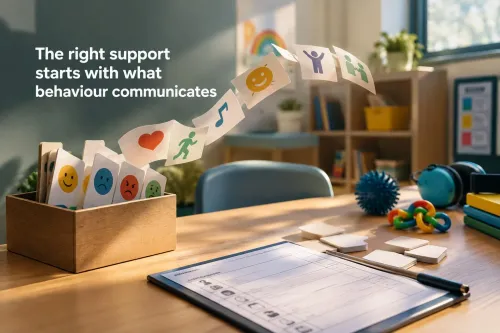

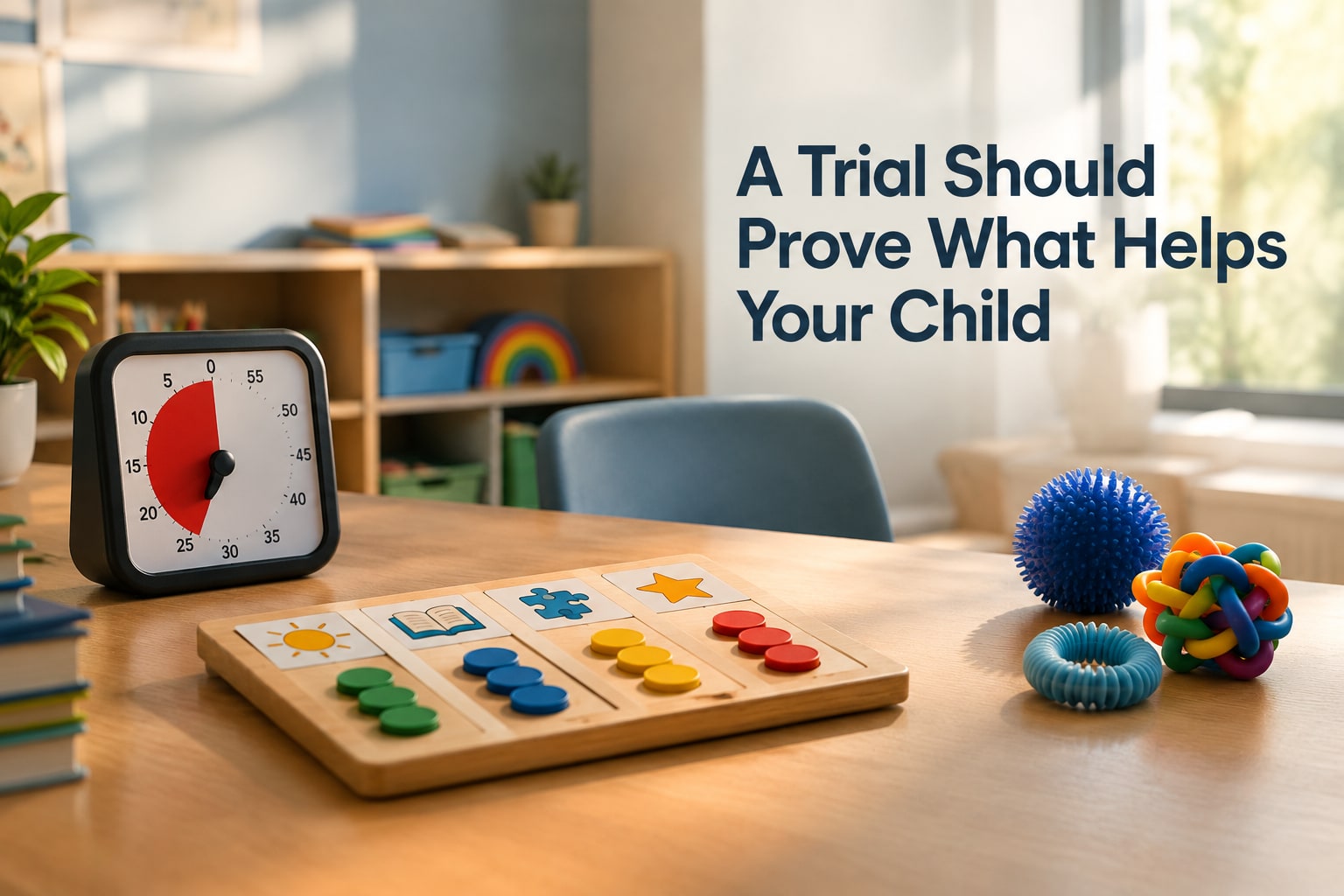
A child hitting during transitions, leaving class after a demand, or screaming when an activity ends needs more than a label such as “challenging behaviour.” By the end, you will know how to judge whether a functional assessment and carefully measured ABA trial fit your child, school, and safety needs.
Key takeaways
- Define behaviours with observable actions, duration, frequency and context.
- Identify what happens before and after behaviour to test its function.
- Require measurable goals, teaching strategies, safety steps and review dates.
- Continue only when data shows meaningful progress without unacceptable distress.
What Does ABA Address in a Special-School Setting?
Hitting another child during a transition, leaving the classroom within 30 seconds of a demand, or screaming for five minutes after a preferred item ends are observable behaviour concerns. They give a team something specific to measure; “bad behaviour” does not.
In a special-school setting, ABA examines what happens before and after an action, measures its pattern, and teaches a replacement skill. A therapist may observe lessons, transitions, group activities, lunch, transport, playground time, and unstructured periods because the same action can have different triggers in each place.
ABA is not a diagnosis, one standardised package, or a synonym for good behaviour or making a child comply.
Before treating the behaviour, ask whether the real difficulty involves communication, pain, sensory overload, anxiety, sleep, learning, attention, or a mismatch between the child and school demands. A search for aba therapy for special school behaviour problems pune or aba therapy for child behaviour difficulties should not replace that question.
1. Define the action, timing, duration, and setting. Record what the child does rather than describing attitude or intention.
2. Identify what the child may be trying to escape, obtain, communicate, or regulate, then teach a usable alternative such as requesting help, a break, attention, or a preferred activity.
3. Check the outcome beyond visible compliance. A plan fails ethically if the child can no longer refuse, request help, communicate pain, or regulate safely.
How Is the Behaviour’s Function and Baseline Established?
1. Before increasing therapy hours, the provider should interview parents about when the behaviour occurs, recent changes at home, communication, sleep, pain, and successful calming strategies. Ask the school team to describe demands, transitions, staff responses, and differences between lessons, lunch, transport, playground time, and home.
2. Require direct observation and an ABC record: what happens immediately before the behaviour, what the child does, and what happens immediately afterward. The pattern may suggest escape from a difficult task, attention, access to an object or activity, sensory input, or communication of pain or another need.
3. Ask for a written baseline in plain language, not “the child is difficult.” It should record frequency, duration, latency, intensity, and the percentage of successful opportunities, such as transitions completed or help requests made. The baseline gives aba behaviour therapy for children pune a measurable starting point and a review target.
4. The assessment should review communication ability, sensory demands, sleep, epilepsy, medication changes, ADHD, anxiety, learning difficulty, trauma, pain, and school or home changes. Sudden aggression, self-injury, loss of skills, or behaviour after a medication change needs medical or mental-health assessment alongside behaviour support; do not wait while ABA is tried.
What Should an Individual Behaviour Plan Include?
Expect a written plan that names one behaviour, explains why it occurs, and sets a review date. A plan that only says “reduce challenging behaviour” cannot show whether ABA therapy for child behaviour difficulties is helping.
1. Define one target in observable terms, such as “hits another child during transitions” or “leaves within 30 seconds of a demand.” Record frequency, duration, intensity, or latency.
2. State the likely function: escape from a task, attention, access to an item or activity, sensory input, or communication of pain or another need.
3. List prevention steps, such as visual warnings, choices, shorter tasks, sensory adjustments, or an easier first demand.
4. Teach a functionally equivalent replacement. The child might request a break, help, attention, or a preferred item instead of shouting, hitting, or leaving.
5. Describe reinforcement. It is whatever consequence increases that replacement behaviour in the child’s future data. Praise, tokens, food, toys, and screen time are not automatically reinforcing; pair preferred consequences with social interaction, then vary or fade them when appropriate.
6. Specify the response to unsafe behaviour, including protection, calm communication, and when to seek medical help. Do not remove the child’s ability to refuse.
7. Set an objective target and review date: fewer incidents per school day, shorter duration, faster recovery, more successful requests, or completed transitions.
Track distress, communication, participation, sleep, injuries, exclusions, and refusal. Suppressing visible behaviour while wellbeing worsens is not success. Evidence is stronger for some autistic-child targets than for every child or every ABA-labelled programme, including ABA behaviour therapy for children Pune families may consider.
How Can the School and Home Make the Trial Work?
A trial works only when the child uses the replacement skill beyond one-to-one sessions. The special school, therapist, and caregivers must agree on the target definition, prompt hierarchy, visual supports, short instruction wording, replacement response, reinforcement rules, and safety procedure.
Put those agreements in writing:
- Practise during lessons, transitions, lunch, transport, playground time, and home routines.
- Offer choices and prevent predictable difficulties before they trigger escalation.
- Reinforce a request for help, a break, attention, or an item immediately.
- Do not provide the desired item only after shouting, hitting, or leaving.
- Fade prompts gradually; success in a therapy room is not generalisation.
Parent and teacher coaching matters because adults control many triggers and consequences. A Pune family considering special school behaviour support pune from SAVI CHILD DEVELOPMENT AND RESEARCH CENTRE PVT LTD can ask how therapists will train school staff, coordinate instructions, and handle unsafe behaviour at home and school.
Set a short trial with a written review date and compare baseline with outcome data. A useful comparison looks like this:
| Measure | Baseline | Trial outcome |
|---|---|---|
| Incidents per school day | 5 | 2 |
| Successful help requests | 1 of 10 opportunities | 7 of 10 |
| Completed transitions | 3 of 8 | 7 of 8 |
Families searching for aba therapy for school behaviour problems pune should judge generalisation, communication, safety, and participation—not the number of therapy hours purchased.
Related service
ABA Therapy Applied Behavior Analysis (ABA) Therapy is a personalized approach that helps children develop important communication, social, learning, and... View service → |
When Is an ABA Trial Worth Continuing or Stopping?
Continue an ABA trial only when an agreed review date brings measurable gains without unacceptable distress. Ask who designs and supervises the programme, what relevant training and registration that person holds, how often supervision occurs, and whether you can inspect raw data rather than a summary graph.
Ask these questions before paying for more sessions:
- What safeguarding process applies to complaints, injuries, suspected abuse, or withdrawal of assent?
- What are the exact procedures for restraint and emergencies, who authorises them, and how is every incident recorded?
- How will the therapist coordinate with the school, train caregivers, and review fees, goals, and implementation?
RCI registration matters for regulated rehabilitation professionals. “ABA therapist” is not, by itself, a nationally uniform Indian licence or proof of competence, so compare the whole plan rather than testimonials or the word ABA.
| Decision | Continue | Change or stop |
|---|---|---|
| Data | Replacement skill, participation, safety, communication, or recovery improves | No meaningful progress by the review date |
| Wellbeing | Distress remains acceptable and refusal or self-regulation is protected | Behaviour worsens, communication is suppressed, or distress rises |
| Delivery | School and caregivers implement the plan consistently | Staff cannot implement it or cannot explain the data |
Families comparing ABA therapy for special school behaviour problems Pune or ABA therapy for school behaviour problems Pune should seek medical, psychological, speech-language, occupational, or educational input when behaviour is sudden, causes injury, follows medication changes, involves lost skills, or suggests pain, seizures, severe anxiety, or another need beyond behaviour therapy.
Frequently asked questions
What behaviour problems can ABA address in a special-school setting?
ABA can address observable concerns such as hitting, leaving class, screaming, refusal, unsafe climbing and difficulty with transitions or communication.
How does a team establish a behaviour baseline?
Record the behaviour’s frequency, duration, intensity, setting, triggers, consequences and time of day before changing the support plan.
What should an individual behaviour plan include?
Include operational definitions, likely behavioural function, replacement skills, teaching procedures, reinforcement, safety responses, data methods, responsible staff and review dates.
When should an ABA trial be continued or stopped?
Continue when agreed measures improve and the child gains useful skills; pause or revise it when progress is absent, distress increases or safety risks remain.