
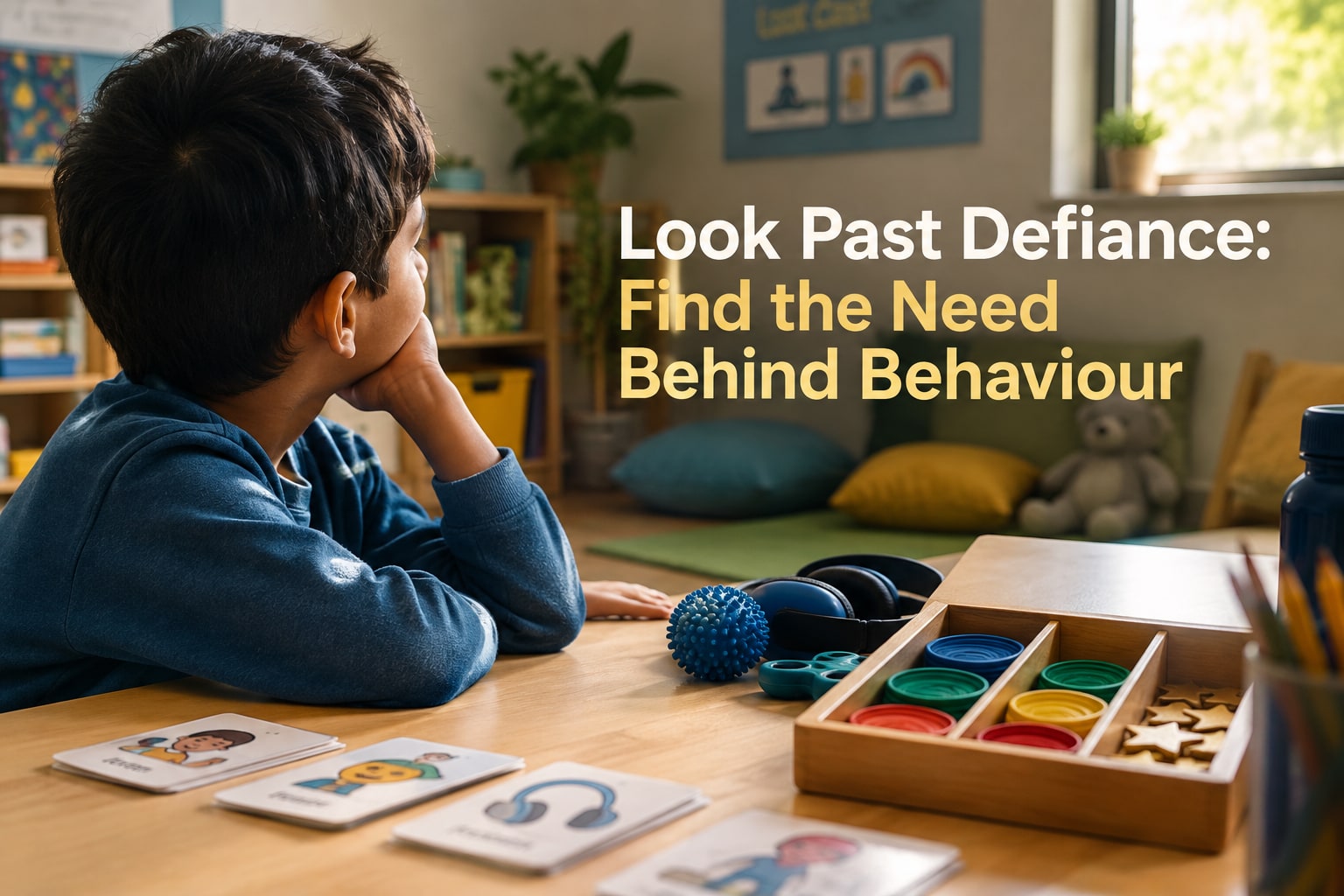
Hitting, bolting, refusal, meltdowns and classroom disruption do not all mean deliberate disobedience. You will learn how to compare rule-based discipline with function-based behaviour support, identify what is driving a behaviour, and judge whether a Pune school or centre has a measurable, dignified plan.
Key takeaways
- Teach communication and coping skills, not only compliance with classroom rules.
- Check whether behaviour signals pain, sensory overload, escape, attention or an unmet need.
- Use visual schedules, functional communication and sensory supports alongside behaviour plans.
- Choose providers who measure goals, involve teachers and review progress with your family.
What is the real difference between ABA and traditional discipline?
Traditional discipline in a special-school classroom means reprimands, repeated instructions, removal of privileges, classroom consequences and reward-based management. These responses enforce a rule, but scolding a child who hits or removing a preferred activity can stop the action briefly without teaching how to request help, escape an unsuitable demand or communicate distress.
| Situation | Traditional discipline | Function-based ABA |
|---|---|---|
| Aggression, hitting or biting | Reprimand, consequence or loss of privilege | Identify what happened before and after, then teach “break,” “help,” waiting or another safe response |
| Bolting, refusal, meltdowns or shouting | Repeated instructions or forced task completion | Adjust the demand, teach communication and reinforce safe participation |
| Task avoidance, toileting incidents, disruption or difficult transitions | Reward compliance or punish interruption | Assess sensory, communication, medical and environmental factors, then teach a usable replacement skill |
The key question in aba therapy or traditional discipline for special school behaviour pune is not whether the child needs rules. It is whether the response teaches safer, more useful behaviour.
Physical punishment, humiliation, threats and coercive restraint are not ordinary classroom consequences; emergency restriction requires a written safety policy, necessity to prevent serious harm and review afterwards.
Ethical ABA is not simply rewards, obedience training or punishment. It uses assessment, skill teaching, reinforcement, dignity and data review. The team should compare baseline with intervention results and change the plan when it fails.
A good outcome includes communication, learning, participation, independence and safety—not merely fewer visible behaviours such as harmless movement or avoiding eye contact.
How can you tell defiance from distress or an unmet need?
You tell defiance from distress by testing what happens before and after the behaviour, not by guessing intent.
Define the target so two staff members would record the same event: “hits another child with an open hand,” “leaves the classroom for more than 10 seconds,” or “screams for longer than 30 seconds.” Record frequency, duration, intensity, location, time, what happened immediately before, and what followed.
Check these possible contributors before choosing ABA or discipline:
- Communication difficulty or anxiety
- Sensory overload, pain or constipation
- Poor sleep or seizures
- Hearing or vision problems
- Bullying or attention differences
- Medication effects
- An academic task that is too difficult
The team can then build a testable hypothesis instead of calling the child naughty, defiant or attention-seeking.
| Observed pattern | Possible function to test | Useful question |
|---|---|---|
| Hitting follows a difficult worksheet | Escape from an unsuitable demand | Did the task stop, change or become easier? |
| Bolting follows an unexpected transition | Escape from uncertainty or sensory distress | Was a warning, visual schedule or break available? |
| Shouting produces adult attention or an item | Access to attention or a preferred object | What did the child receive immediately afterwards? |
Ask for baseline data, the suspected function, the replacement skill, the safety response and the review date. This is the foundation of aba therapy for school behaviour problems pune, not proof that every behaviour needs intensive therapy. A written plan should also state how your child can request help, refuse safely or take a break.
What does function-based teaching look like in the classroom?
A daily function-based plan turns assessment into teachable moments. If a child hits to escape a difficult worksheet, staff teach “break,” “help,” task negotiation or waiting, then reinforce that communication before escalation.
| Situation | Function-based teaching | Discipline-only response |
|---|---|---|
| Difficult task | Request a break, help, or an easier step | Scolding or removing a privilege |
| Pain or distress | Point to a pain symbol and alert an adult | Repeated instructions to continue |
| Unavailable preferred item | Use a visual choice board or request the item | Withhold the item without teaching a request |
| Transition | Follow a timer, visual schedule, or first-then cue | Consequence after bolting or refusal |
| Group activity | Join, wait for a turn, and participate safely | Reprimand shouting or disruption |
Positive reinforcement is not bribery when the meaningful consequence follows the replacement skill immediately: a break after an appropriate break request, help after asking, or access to an activity after safe participation. Staff first identify what motivates that child; praise, stickers and food do not work equally for everyone.
The team should pair rewards with natural outcomes such as communication, independence, social participation and access to activities. Prompts guide success, but staff fade them only after the skill is reliable; removing support too early can make a new response fail.
Review frequency, duration or intensity against baseline, check whether the skill generalises across people and settings, and change the plan when the target does not improve. That testable process is the practical distinction in aba therapy versus discipline for school behaviour pune.
Which school supports can work alongside or instead of one-to-one ABA?
A child does not need one-to-one ABA for every school difficulty. Teachers and therapists can combine environmental supports with behaviour therapy, or use them instead when the main barrier is an unclear routine, difficult task, communication gap or transition.
| Support | What it does | Who can deliver it |
|---|---|---|
| Visual schedule, picture symbols or communication device | Shows what happens next and provides a way to request help, a break or an item | Teacher, therapist and family |
| Advance warning, timer and first-then instruction | Makes transitions and delayed access predictable | Classroom staff and transport staff |
| Task modification and structured choices | Reduces failure by changing the task or offering two acceptable options | Teacher and special educator |
| Predictable toileting routine and individually indicated sensory break | Addresses daily-care needs or overload without rewarding escalation | School team and family |
Choose targets that affect safety or participation, such as hitting, bolting, prolonged refusal or distress. Do not make harmless hand-flapping, movement or avoidance of eye contact a goal simply because it looks different.
Review the plan against attendance, learning, communication, sleep, distress, peer participation, independence, safety, prompt reduction and persistence outside therapy. Practise skills with the teacher, peers, transport staff and family in Marathi-, Hindi- and English-speaking routines; one language need not be treated as the only acceptable option.
NICE recommends a psychosocial intervention based on functional assessment, a behaviour-change strategy and outcome evaluation. Medication is not a routine substitute and requires specialist oversight in defined circumstances. These are practical special school behaviour therapy alternatives Pune, not competing labels every child must receive.
How should a Pune family choose and monitor a provider?
A provider earns trust by showing how its plan will be tested, not by promising a fixed number of ABA hours. A family searching aba therapy for school behaviour problems pune should compare evidence, supervision and fit with the child’s goals, tolerance, family capacity and school routine.
Ask for a written plan that names:
- The observable target behaviour and baseline
- The replacement skill and measurement method
- Each staff member’s responsibilities
- The consent process and crisis procedure
- The review date and examples of recorded data
| Check | Ask the provider | Why it matters |
|---|---|---|
| Expertise | Who designs, supervises and implements the plan? | Separates clinical accountability from marketing |
| Registration | Is the relevant practitioner currently registered with the Rehabilitation Council of India? | A workshop certificate is not equivalent to RCI registration |
| Consistency | Will teachers, therapists, family and transport staff use the same signals and reinforcement? | Prevents confusion across settings and Marathi, Hindi and English routines |
| Autonomy | How can the child refuse, request help or take a break? | Protects communication, safety and dignity |
SAVI CHILD DEVELOPMENT AND RESEARCH CENTRE PVT LTD may suit a family wanting assessment, therapy, education and care considered together, but a centre’s label does not prove that its behaviour plan is appropriate.
For aba therapy versus discipline for school behaviour pune, reject promises of a cure or guaranteed obedience. Choose the plan that reduces harm, builds usable skills and shows improvement at home, school and in the community.
Related services
Occupational Therapy For Children In Pune Occupational Therapy For Children In Pune Occupational therapy plays a crucial role in helping children with special needs, particularly those diagnosed with autism, achieve greater... View service → |
ABA Therapy Applied Behavior Analysis (ABA) Therapy is a personalized approach that helps children develop important communication, social, learning, and... View service → |
Frequently asked questions
What is the difference between ABA therapy and traditional discipline for school behaviour?
Traditional discipline focuses on consequences after rule-breaking. ABA examines what happens before and after behaviour, identifies its function, and teaches a safer replacement such as requesting help or a break.
How can you tell defiance from distress or an unmet need?
Track the situation, demand, communication attempts, sensory conditions and physical symptoms. Behaviour linked to noise, pain, fatigue, difficult tasks or lost communication opportunities may signal distress rather than deliberate defiance.
What does function-based teaching look like in a special-school classroom?
Staff identify the behaviour’s purpose, teach a replacement response, practise it during real routines, and reinforce the response consistently. A child might learn to show a break card instead of hitting during a difficult task.
Which school supports can work alongside or instead of one-to-one ABA?
Visual schedules, first-then boards, functional communication training, predictable routines, sensory supports, task adaptations, social stories and staff training can support behaviour without relying only on one-to-one ABA.
How should a Pune family choose and monitor a behaviour-support provider?
Ask for written goals, baseline observations, data definitions, staff qualifications, school collaboration plans and review dates. Monitor whether skills transfer across people and settings, and whether challenging behaviour decreases without excessive restriction.
Related services
Sensory Integration The early years of childhood are a crucial period for learning and development. View service → |
Early Intervention . Early Intervention Centre Services Can Make a Meaningful Difference The early years of childhood are a crucial period for learning and development. View service → |
Special Education provides personalized learning and developmental support for children with different learning needs and abilities. View service → |
Speech Therapy At Savi ChildCare, our specialized Speech Therapy services help children develop effective communication and language skills in a supportive,... View service → |