

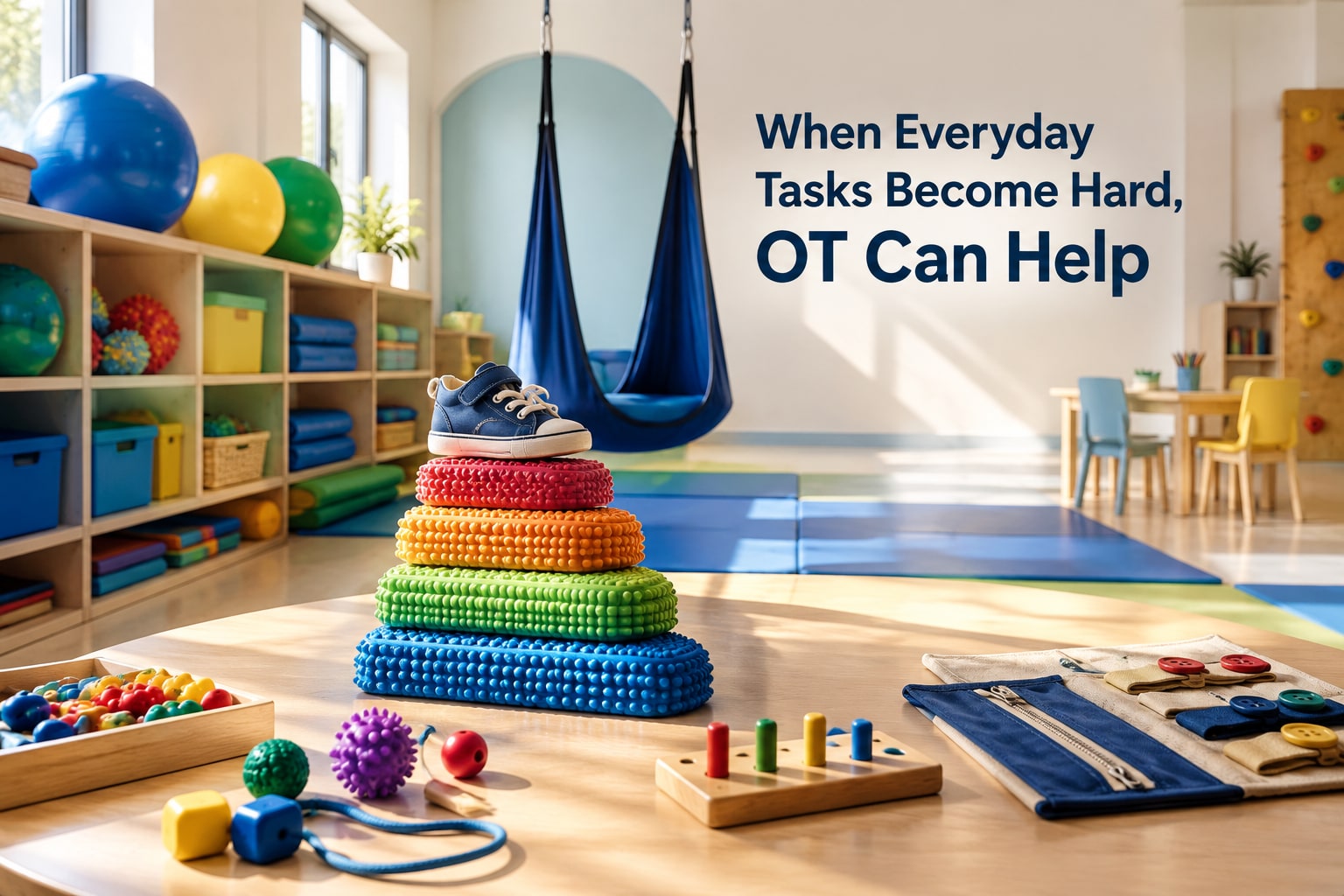
A child may need occupational therapy when everyday activities—dressing, eating, playing, writing, moving safely, or joining classroom routines—remain harder than expected. By the end, you will be able to match common difficulties to occupational therapy, recognise signs that warrant an assessment, understand what sessions involve, and know when another professional or medical evaluation is needed.
Key takeaways
- Focus on participation in dressing, feeding, toileting, play, and schoolwork.
- Request an assessment when difficulties persist, limit safety, or disrupt daily routines.
- Choose goals you can observe at home, school, and in community settings.
- Ask how occupational therapy will coordinate with speech, physiotherapy, or special education.
Which everyday problems can pediatric occupational therapy address?
Occupational therapy helps when a child’s difficulty disrupts daily occupations: dressing, toileting, feeding, play, schoolwork, or social routines. Occupational therapy for developmental problems is available with or without a formal diagnosis; the key question is whether the child can participate independently and safely.
Common occupational therapy problems children can get help with in Pune include:
- Fine-motor delay, difficulty using both hands together, an awkward pencil grip, cutting, drawing, handwriting, buttoning, or using utensils.
- Trouble dressing, managing fasteners, completing toilet steps, sitting for meals, avoiding food textures, or following feeding routines.
- Frequent falls, poor playground skills, weak body awareness, difficulty planning movements, or unsafe climbing and running.
- Losing focus, struggling with transitions, disorganised classroom materials, or failing to stay engaged in age-expected play.
| Observation | Ordinary variation | Functional concern |
|---|---|---|
| Weak pencil grip | The child writes clearly and keeps pace | Writing is painful, very slow, illegible, or avoided |
| Preference | The child chooses one hand or avoids a texture but completes tasks | The child cannot use both hands, handle materials, or join meals |
| Clumsiness | Occasional trips without disruption | Frequent falls, unsafe movement, or inability to join playground games |
| Self-care pace | Needs occasional help | Cannot complete age-expected dressing, utensil, or toileting tasks |
A preference or weak grip alone is not enough. Repeated avoidance, distress, dependence, or lost participation shows that assessment is worth considering.
When do these signs justify an occupational therapy assessment?
Repeated difficulty across home, school, and play supports an occupational therapy assessment more than a single preference or bad day. Arrange an assessment when distress, lost independence, safety risks, or a widening gap with classroom demands affects participation.
Use this checklist:
- The child struggles with posture, balance, coordination, motor planning, or frequent falls in more than one setting.
- The child cannot use both hands together, grasp and release objects, manage clothing, utensils, or classroom tools.
- Sensory responses disrupt play, grooming, feeding routines, transitions, or staying engaged.
- The child needs much more help than peers with self-care or cannot follow or communicate a familiar routine.
- Teachers report difficulty with classroom tasks, organisation, copying, handwriting, or moving between activities.
- A caregiver or teacher sees unsafe movement, intense distress, or avoidance that blocks participation.
The occupational therapist should observe posture, balance, hand use, play, self-care, sensory responses, classroom tasks, transitions, and motor planning in context. Ask how caregiver and teacher reports will be included, and request home or school observation where possible.
A sensory checklist or isolated motor test can add information, but neither proves why a real-life task is failing.
Do not label every refusal a sensory problem. Check for pain, vision or hearing difficulty, poor sleep, hunger, language difficulty, or an unmet communication need, and seek the appropriate assessment. This matters whether you search for occupational therapy for children problems pune or occupational therapy for sensory difficulties pune.
What happens in sessions, and how is progress made useful outside the clinic?
Sessions practise the real tasks that limit a child’s participation, not just isolated hand or strength exercises. A child might fasten clothing, open a lunch container, use scissors, copy classroom work, manipulate small objects, balance, catch a ball, sequence a toilet routine, tolerate a grooming step, or join a shared game.
- The therapist breaks the task into manageable steps. For developmental coordination difficulties, practising dressing, handwriting, ball skills, or cycling in graded steps has more practical relevance than exercises alone.
- The therapist adjusts the challenge and records an observable baseline. A goal might be completing three dressing steps, opening a lunchbox independently, or remaining in a classroom task for 10 minutes.
- The therapist coaches caregivers and coordinates with teachers. Changes might include repositioning paper, trying a different pencil, reducing copying, allowing extra time, adding visual steps, or offering another way to show knowledge.
- The family practises selected steps at home, using ordinary routines rather than lengthy drills. The therapist reviews performance over time and changes the plan when progress stalls, fatigue rises, or the task becomes easier.
Session length and frequency depend on age, goals, fatigue, diagnosis, language, school demands, and family routines, so there is no useful standard schedule. Progress means a skill transfers to home, school, or play: fewer prompts, less distress, safer movement, faster completion, or greater independence.
Families seeking child occupational therapy support in Pune can ask how occupational therapy for developmental problems will produce measurable change outside the clinic.
How does occupational therapy fit with other child-development services?
Occupational therapy focuses on participation: self-care, play, school tasks, and daily routines. Searches such as “occupational therapy for children problems Pune” or “occupational therapy for sensory difficulties Pune” should not replace matching the professional to the problem. These services can coordinate rather than compete.
| Service | Main focus | Refer when |
|---|---|---|
| Occupational therapy | Dressing, toileting, utensil use, handwriting, play, routines, and participation | Motor, sensory, self-care, or classroom tasks limit daily life |
| Speech therapy | Language, communication, understanding, and social communication | The main difficulty is expressing, understanding, or using language |
| Physiotherapy | Mobility, strength, balance, posture, and gross-motor function | Falls, walking, transfers, or physical movement are the main concerns |
| ABA therapy | Structured behavioural and learning goals | A team identifies measurable behaviour, teaching, or learning targets |
| Sensory-focused occupational therapy | Analysing triggers and improving participation in real activities | Sensory responses disrupt grooming, meals, transitions, play, or school |
| Oral placement therapy | Oral-motor and feeding or speech movements | A qualified provider identifies specific oral-motor movement needs |
| Special education | Curriculum access, classroom adaptations, and learning support | The child needs modified teaching or alternative ways to demonstrate knowledge |
Refer urgently for choking, coughing during meals, a wet or gurgly voice, recurrent chest infections, dehydration, poor growth, or suspected swallowing impairment. A paediatrician and speech-language pathologist or feeding specialist may be needed. New loss of skills, significant pain, seizures, serious falls, breathing difficulty, or immediate safety risk also require medical assessment.
Vision, hearing, sleep, and other medical concerns need the appropriate professional.
How should Pune families choose an occupational therapy assessment?
Before booking, ask who will assess your child and how the findings will guide daily participation. Families seeking child occupational therapy support Pune should ask:
- What professional qualification does the therapist hold?
- What experience do they have with this specific difficulty, diagnosis, age, and language?
- Which assessment methods will they use across home, school, play, and self-care?
- What two or three observable goals will they set?
- What home or school practice is expected, and when is the first review?
- Which measure will track change?
Age, developmental profile, classroom expectations, caregiver availability, commute, and Pune school routines can alter the plan.
| Factor | Ask how it changes the plan | Why it matters |
|---|---|---|
| Age and profile | Which task matches the child’s present ability? | A preschool dressing goal differs from a school handwriting goal. |
| Language and classroom | How will instructions, copying, and participation be assessed? | Language difficulty can look like poor attention or motor difficulty. |
| Routine and access | Can caregivers practise, and can the child attend consistently? | A distant clinic or rigid school timetable can undermine carryover. |
A centre offering many therapies does not prove that every therapy is needed. Treat sensory-integration therapy as a time-limited trial with measurable functional goals, not a guaranteed cure; stop or revise it if participation does not improve.
Families can use an initial discussion with SAVI CHILD DEVELOPMENT AND RESEARCH CENTRE PVT LTD to ask how therapy would address one daily task and coordinate with caregivers, school staff, and other professionals. This is especially important when comparing occupational therapy problems children can get help with Pune.
Related services
Occupational Therapy For Children In Pune Occupational Therapy For Children In Pune Occupational therapy plays a crucial role in helping children with special needs, particularly those diagnosed with autism, achieve greater... View service → |
Sensory Integration The early years of childhood are a crucial period for learning and development. View service → |
Frequently asked questions
Which everyday problems can pediatric occupational therapy address?
It can address difficulties with dressing, toileting, feeding, handwriting, classroom tasks, play, sensory responses, coordination, and daily routines.
When should a child have an occupational therapy assessment?
Consider an assessment when a repeated difficulty limits participation, independence, safety, learning, play, or family routines, with or without a formal diagnosis.
What happens during pediatric occupational therapy sessions?
The therapist observes the child’s functional difficulties, sets practical goals, uses targeted activities, and checks whether skills transfer to home and school.
How does occupational therapy fit with other child-development services?
Occupational therapy can work alongside speech therapy, physiotherapy, special education, developmental care, and medical guidance when a child has overlapping needs.
How should Pune families choose an occupational therapy assessment?
Ask about the therapist’s pediatric experience, assessment methods, measurable goals, home practice, progress reviews, and coordination with the child’s other services.
Related services
Early Intervention . Early Intervention Centre Services Can Make a Meaningful Difference The early years of childhood are a crucial period for learning and development. View service → |
Oral Placement Therapy (OPT) focuses on improving the awareness, strength, coordination, and movement of the muscles involved in speech, feeding, and oral motor... View service → |
Speech Therapy At Savi ChildCare, our specialized Speech Therapy services help children develop effective communication and language skills in a supportive,... View service → |
Neuro Development focuses on supporting a child’s overall growth by strengthening cognitive, motor, communication, social, and emotional skills. View service → |