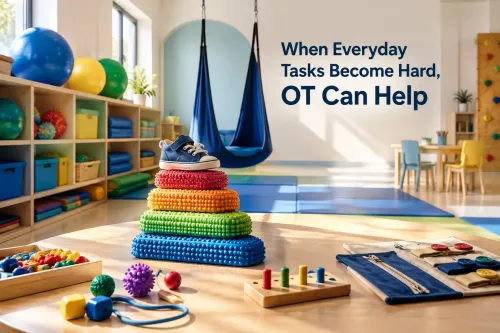

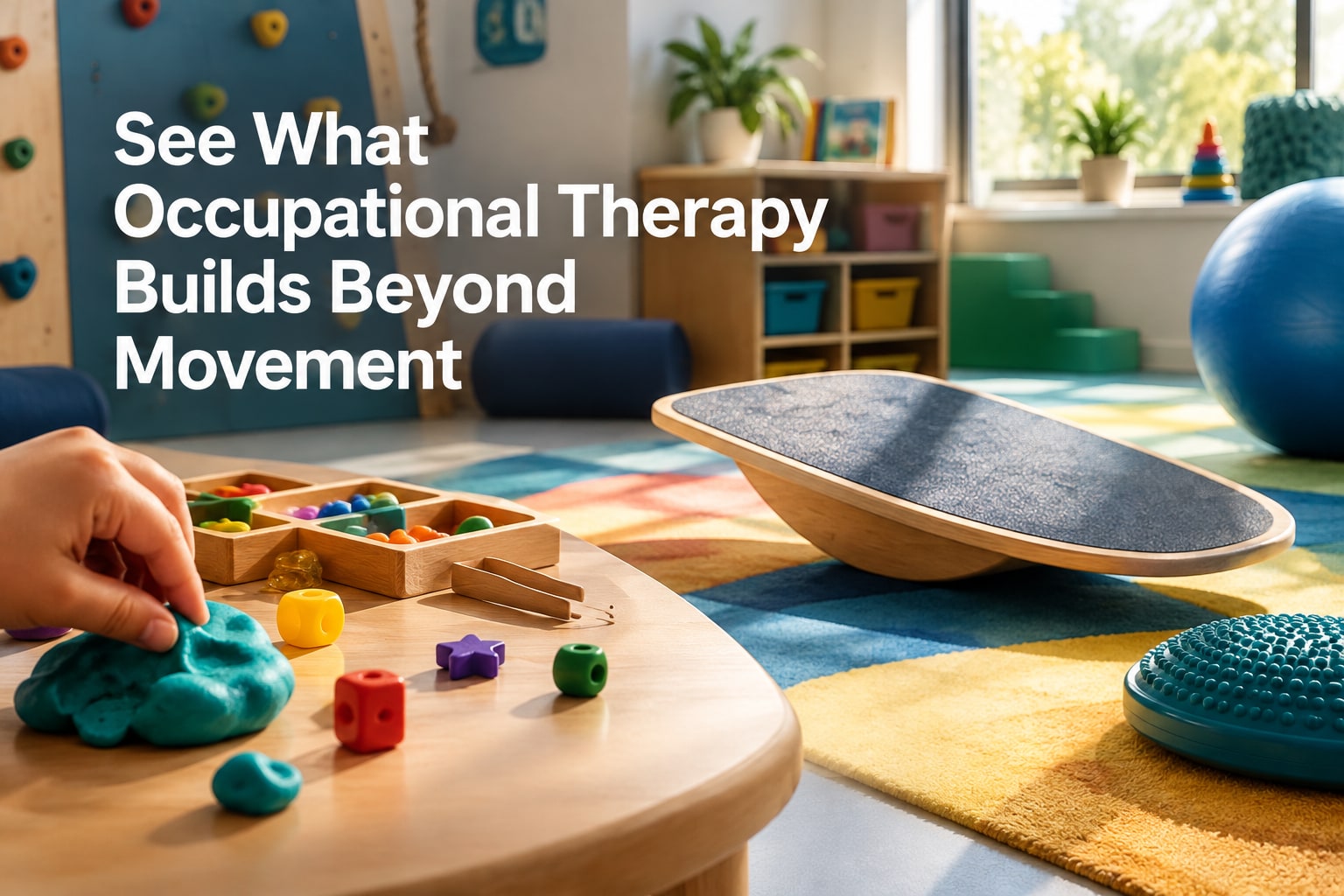
Occupational therapy for a child is about taking part in everyday life, not preparing for a job. By the end, you will know which difficulties justify an assessment, what happens during sessions, how OT differs from other therapies, and what to ask before choosing a service in Pune.
Key takeaways
- OT builds participation in dressing, eating, play, learning and other daily activities.
- Ask how each activity connects to your child’s specific home, school or self-care goals.
- A useful assessment observes movement, sensory responses, communication and everyday task performance.
- Choose a plan with measurable goals, home practice and a clear review date.
What occupational therapy means for a child
The practical answer to “what is occupational therapy for children Pune?” is help with taking part in everyday life. A paediatric occupational therapist uses meaningful play, practice and daily activities to build participation, independence and confidence.
“Occupation” means a child’s activities, not future job training, and isolated hand exercises are only useful when they support a real task.
Childhood occupations include:
- Dressing, bathing and toileting
- Eating, using a spoon and opening containers
- Classroom work, handwriting and using school tools
- Playground play, social participation and joining games
- Sleep routines and moving between activities
The occupational therapy meaning for children Pune families need is practical: the therapist considers the child, the activity and the setting. Can the child use a spoon at home, manage a lunch box at school, or put on a shirt with fewer prompts?
A goal such as “improve fine-motor skills” is incomplete until it names the daily change, such as cutting paper for a classroom task.
OT may overlap with other services, but each has a different main focus:
| Service | Main focus | Example |
|---|---|---|
| Occupational therapy | Participation in daily tasks | Dressing or classroom access |
| Physiotherapy | Strength, movement and mobility | Walking or balance |
| Speech therapy | Communication, language and swallowing | Requesting help |
| Special education | Learning and academic access | Adapting written work |
| ABA | Behaviour-based skill teaching | Building a routine |
| Sensory integration | One possible OT approach | Supporting participation through sensory-motor activities |
What happens during a paediatric OT session—and how it differs from other therapies
A typical paediatric OT session starts with observation, not a worksheet. Through play, the therapist watches posture, movement, attention, motor planning, problem-solving, and interaction, then chooses tasks linked to the child’s daily goals. This is child occupational therapy explained through participation rather than isolated hand exercises.
Activities may include:
- Climbing, balancing, pushing, or other movement challenges
- Cutting, drawing, fastening buttons, using utensils, or completing two-handed tasks
- Rehearsing dressing, handwashing, feeding, toileting, or transitions
- Adapting a home or school routine and coaching the parent to practise it
The disciplines overlap, but their main questions differ:
| Discipline | Main focus | Example functional goal |
|---|---|---|
| Occupational therapy | Self-care, play, motor planning, regulation, classroom participation, and adaptations | Put on a shirt with fewer prompts |
| Physiotherapy | Movement, strength, balance, mobility, and physical function | Walk safely between classroom areas |
| Speech therapy | Communication, language, social communication, and swallowing-related needs | Request help or manage safe swallowing |
| Special education | Teaching methods, learning access, and academic participation | Complete classroom work using adapted instruction |
| ABA | Behavioural principles for teaching skills and reducing barriers | Follow a routine with fewer disruptive behaviours |
Sensory integration is one possible OT approach, not a name for every sensory activity or a universal treatment. Its use should connect to a functional goal and include monitoring, since evidence remains limited.
A child may need two or more disciplines: OT for dressing and classroom participation, speech therapy for communication, and physiotherapy for mobility. Ask the team to agree on shared goals so exercises support the same real-life routines.
Which signs suggest an occupational therapy assessment is useful?
An occupational therapy assessment can be useful even without a formal diagnosis when everyday tasks require unusual effort, distress, or adult help. Look for patterns such as:
- Avoiding particular clothing textures or becoming distressed during hair washing or tooth-brushing
- Difficulty using a spoon or fork, spilling frequently, or needing help with feeding
- Poor pencil control or tiring quickly during drawing
- Frequent falls, bumping into objects, or difficulty copying actions
- Trouble sitting for a task, using both hands together, or planning a new movement
- Dependence on adults for age-expected dressing, toileting, feeding, or school routines
| Pattern | What you may notice | What assessment explores |
|---|---|---|
| Sound, touch, smell, or visual input | Covers ears, rejects textures, dislikes smells, or becomes overwhelmed by busy rooms | How sensory responses affect dressing, hygiene, eating, learning, or participation |
| Movement or pressure seeking | Crashes into furniture, spins, jumps, or pushes heavily to stay organised | Balance, body awareness, attention, and safer ways to join activities |
| Motor and routine difficulty | Falls, spills, tires during drawing, or needs repeated prompts | Posture, coordination, motor planning, hand use, and task demands |
Pushing a laundry basket or playing with play dough at home is not automatically sensory integration therapy. A therapist should connect any sensory-based approach to a functional goal, monitor the child’s response, and explain that evidence is limited. Sensory work is not a cure for autism, ADHD, developmental delay, or behaviour problems.
Bring videos or teacher observations, especially when seeking occupational therapy for special needs children Pune.
What an occupational therapy assessment in Pune should include
A complete occupational therapy assessment in Pune is more than a test score. It combines a caregiver interview, developmental and medical history, current routines, school demands, and the child’s strengths with direct observation of how the child functions.
| Assessment area | What the therapist examines | Why it matters |
|---|---|---|
| History and routines | Development, medicines, diagnoses, home and school demands | Identifies patterns across settings |
| Functional observation | Play, transitions, self-care, classroom-type tasks, movement | Shows what support the child needs |
| Screening | Motor, visual-motor, postural, bilateral coordination, sensory skills | Links underlying skills to daily difficulties |
| Standardized testing | Named tools selected for the referral question | Adds comparable information without replacing observation |
Bring school reports, previous therapy records, developmental evaluations, videos of difficult routines, and a medicine or diagnosis list when relevant. Describe what happens immediately before and after the difficulty, how much help your child needs, and whether it occurs at home, school, or both.
The therapist should end with measurable functional goals, such as:
- Tolerating tooth-brushing
- Opening a lunch box
- Joining a play routine
- Putting on a shirt with fewer prompts
Ask how practice will be planned, measured, reviewed, and referred onward. When comparing providers, ask who will assess your child, their training and registration, the tools used, report-sharing arrangements, and how feeding, movement, and sensory risks are handled.
Families considering SAVI CHILD DEVELOPMENT AND RESEARCH CENTRE PVT LTD can use these questions to test whether the proposed assessment reflects home and school priorities.
Related services
Occupational Therapy For Children In Pune Occupational Therapy For Children In Pune Occupational therapy plays a crucial role in helping children with special needs, particularly those diagnosed with autism, achieve greater... View service → |
Sensory Integration The early years of childhood are a crucial period for learning and development. View service → |
How to judge the plan after assessment
After the first evaluation, a practical plan tells you what will change in daily life, not merely “improve sensory processing.” It names the target routine, the child’s starting level, the help required, the practice adults will use, how progress will be measured, and when it will be reviewed.
1. Ask the therapist to demonstrate each strategy and adapt it to your home routine. A plan that requires equipment, time, or handling your family cannot provide will fail outside the clinic.
2. Ask why this session frequency fits your child. Frequency depends on the goals, performance across settings, access to practice, family capacity, and response to treatment—not a fixed prescription.
3. Ask whether the therapist will communicate with school staff when you give consent, and how they will check that skills such as dressing, utensil use, or classroom participation generalise beyond the clinic.
4. Ask how feeding, movement, and sensory risks will be assessed and managed. Searches for “what is occupational therapy for children Pune” or “occupational therapy for special needs children Pune” should lead to these practical questions, not promises of a universal programme.
OT can support self-care, play, regulation, motor skills, and participation. It does not replace medical assessment, speech therapy, physiotherapy, special education, or psychological care when indicated. Seek prompt medical attention for lost skills, seizures, swallowing or breathing difficulty, persistent pain, sudden weakness, or another acute change.
Frequently asked questions
What is occupational therapy for children in Pune?
Paediatric occupational therapy helps children take part in everyday activities such as dressing, eating, playing, learning and managing routines. Therapy uses meaningful play, practice and task adaptations to build participation and independence.
What happens during a paediatric occupational therapy session?
The therapist may observe play, fine-motor tasks, movement, sensory responses, attention and daily activities. Sessions use goal-based activities, and the therapist explains how practice connects to home or school needs.
Which signs suggest that a child needs an occupational therapy assessment?
Consider an assessment when difficulties with dressing, feeding, handwriting, using tools, coordination, sensory responses, attention or daily routines interfere with home, school or play.
What should an occupational therapy assessment in Pune include?
A thorough assessment includes your concerns and goals, developmental and medical history, observation of relevant tasks, standardised or structured measures when appropriate, and practical recommendations for home and school.
How can parents judge an occupational therapy plan after assessment?
Look for specific functional goals, activities linked to those goals, a home-practice plan, measurable progress indicators and a review date. Ask how the therapist will adjust the plan if progress stalls.
Related services
Early Intervention . Early Intervention Centre Services Can Make a Meaningful Difference The early years of childhood are a crucial period for learning and development. View service → |
Oral Placement Therapy (OPT) focuses on improving the awareness, strength, coordination, and movement of the muscles involved in speech, feeding, and oral motor... View service → |
ABA Therapy Applied Behavior Analysis (ABA) Therapy is a personalized approach that helps children develop important communication, social, learning, and... View service → |
Neuro Development focuses on supporting a child’s overall growth by strengthening cognitive, motor, communication, social, and emotional skills. View service → |