

A child who is hard to understand may have a speech-sound difficulty, a language delay, a hearing problem, a fluency difference, or a broader developmental need. By the end, you will know which signs warrant assessment, what happens during the first visit, and how to compare speech-language services in Pune.
Key takeaways
- Separate speech-sound, language, fluency and motor-planning difficulties.
- Use assessment findings to set measurable communication goals.
- Plan for multilingual communication instead of discouraging home languages.
- Choose therapy that carries into home, school and everyday conversations.
Is the problem speech, language, or both?
A child can pronounce words clearly yet struggle to understand instructions, find words, build sentences or take turns in conversation. Another child may understand everything but remain difficult to understand because of speech-sound errors, motor-planning difficulty or stuttering.
| Feature | Speech | Language |
|---|---|---|
| Articulation and sound patterns | Producing and organising speech sounds | Understanding and using words |
| Motor planning, fluency and voice | Coordinating movements, managing stuttering, and producing an appropriate voice | Grammar, sentence building and expressing needs |
| Communication use | Clarity, pace and smoothness | Gestures, conversation and social communication |
Unclear speech, limited vocabulary, late talking, difficulty combining words, echolalia, stuttering, unusual voice quality and trouble following simple directions all justify watching the broader pattern, not labelling a disorder from one missed milestone. Milestones guide action; they do not diagnose.
A child may have clear pronunciation with weak language, or strong understanding with speech that others cannot follow.
Seek an assessment when familiar adults struggle to understand the child, communication regularly causes frustration, or the child uses fewer words or word combinations than expected for their development. Loss of words, gestures or other acquired skills needs prompt attention.
Sudden speech change, weakness, swallowing difficulty, seizures or other neurological symptoms require medical evaluation rather than waiting for routine therapy. Searching for speech therapy pune for communication problems or speech and language therapy pune should lead to assessment of the specific difficulty, not pronunciation drills by default.
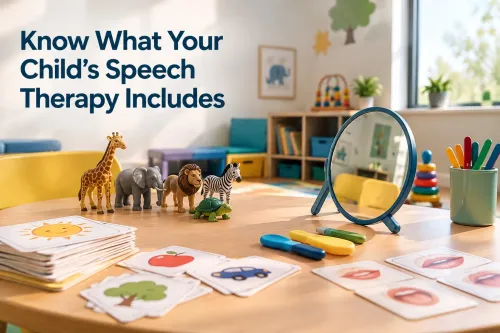
What happens during a child speech and language assessment?
A first assessment combines a parent interview with direct observation, and hearing must be investigated alongside communication. The clinician reviews birth, medical, developmental, communication and school history, then identifies whether the difficulty involves speech, language, or both.
The session may include:
- Play-based observation, comprehension tasks and expressive-language activities
- Speech-sound sampling, conversation and fluency observation
- Questions about oral-motor skills, chewing or feeding when relevant
- Review of previous reports, hearing-test results and school observations
- Short home videos and a list of difficult words, situations or instructions
Bring these materials to the appointment. They show how the child communicates outside a structured clinic session.
The clinician separates articulation or phonological errors from motor-speech difficulty by examining consistency, sound transitions, speech coordination and prosody. The assessment also considers language delay, stuttering, voice differences, social-communication differences and broader developmental concerns.
A child may need a different plan for each problem; speech therapy for children Pune should not mean pronunciation drills by default.
Hearing matters because mild or fluctuating loss from ear infections can reduce access to speech sounds and spoken instructions, making a child seem inattentive. Arrange an audiologist or paediatrician review in Pune for hearing concerns, recurrent ear infections, inconsistent responses to sound, sudden change or other medical symptoms.
Therapy alone cannot establish whether hearing loss or a middle-ear problem affects communication. This is why speech and language therapy Pune begins with a clear profile, not a label.
How should therapy address multilingual communication and different needs?
Therapy should match the child’s communication profile, not default to pronunciation drills. Tell the clinician every language the child hears and uses, who speaks each language, and where communication breaks down. Learning two or more languages does not cause a language disorder.
Concern rises when difficulty affects communication across the child’s languages; vocabulary in one language may look smaller when counted separately.
A search for speech therapy for children Pune or speech therapy pune for communication problems should lead to a broad assessment. Possible targets include:
- Speech-sound patterns and articulation
- Receptive language, including understanding instructions
- Expressive language, including vocabulary, grammar and sentences
- Social communication, such as conversation and turn-taking
- Fluency, voice and motor speech
- Augmentative and alternative communication (AAC)
AAC may combine gestures, signs, picture boards and speech-generating devices. It gives a child a way to request, reject, answer and participate while speech develops; it does not prevent speech.
Persistent inconsistent sound errors, disrupted transitions between sounds, unusual prosody or difficulty coordinating speech movements need evaluation for motor-speech problems rather than routine articulation treatment. For stuttering, assess repetitions, prolongations, blocks, physical tension, avoidance, participation and the child’s feelings—not only the number of disfluencies.
A child may need language support, AAC or fluency therapy even when pronunciation is clear.
What makes a speech therapy plan useful outside the clinic?
A useful plan targets a daily communication outcome, not a vague promise to “improve speech.” Ask for a starting point, observable goals and review dates. A search for speech and language therapy Pune or child speech therapy near me should lead to this discussion, not a fixed-result guarantee.
| Outcome | Evidence of progress | Practice outside the clinic |
|---|---|---|
| Being understood by teachers | Teacher rates familiar words as clear | Model the target word during play and school routines |
| Following two-step directions | Child completes both steps without repeated prompts | Give directions during dressing or meals |
| Asking for help or answering questions | Child uses words, gestures, pictures or a device | Offer two choices, wait, then respond |
| Combining words or taking turns | Child produces a longer phrase or completes more conversational turns | Expand the child’s words during book-sharing |
| Reducing speaking-related avoidance | Child joins conversations with less tension or withdrawal | Accept communication attempts without pressure |
Caregiver coaching should specify what you do: model a short phrase, wait for a response, expand the child’s words, and accept a gesture or picture while spoken language develops. Ask how the plan changes if progress is limited and whether teachers can use the same supports.
If the child stutters, do not say “slow down,” “start over,” or “think before speaking.” These commands can increase self-consciousness without treating the difficulty. Ask when developmental pediatrics, psychology, occupational therapy, physiotherapy, special education, audiology or feeding services should join the plan.
How do you choose speech therapy for children in Pune?
Distance should not decide a child speech therapy near me search. Compare how well each service identifies the child’s actual communication problem and builds a plan for home, school and community use.
Ask these questions before booking:
- Who will assess my child? Ask about the speech-language pathologist’s current Rehabilitation Council of India registration, relevant training and experience with the child’s age and difficulties.
- Will the intake screen hearing, development, feeding or oral-motor concerns? Ask whether referrals to an audiologist or paediatrician are made when needed.
- Which languages will the assessment cover? Tell the clinician every language your child hears and uses.
- How will progress be measured, and when will goals be reviewed? Look for observable outcomes such as asking for help, following directions or being understood at school.
- What home practice will parents receive? Ask for specific activities, not only “talk more.”
- Can the service coordinate with an audiologist, paediatrician, school or other therapists when needs cross disciplines?
Check the intake against these signs:
| Check | Strong answer | Warning sign |
|---|---|---|
| Functional target | Names the daily communication difficulty | Treats “speech therapy” as one intervention |
| Assessment scope | Covers speech, language, fluency and social communication as relevant | Offers pronunciation drills immediately |
| Progress plan | Records a baseline and review date | Promises an outcome without measures |
For families comparing speech therapy pune for communication problems, SAVI CHILD DEVELOPMENT AND RESEARCH CENTRE PVT LTD in Sinhgad Road, Pune, can be one provider evaluated using this checklist. The best choice is the service that explains the communication profile and adapts the plan when progress stalls.
Related service
Speech Therapy At Savi ChildCare, our specialized Speech Therapy services help children develop effective communication and language skills in a supportive,... View service → |
Frequently asked questions
How can you tell whether a child has a speech or language difficulty?
Speech difficulties affect how clearly a child produces sounds, plans movements or manages fluency. Language difficulties affect understanding, vocabulary, sentences or conversation. A child can have both, so assessment matters.
What happens during a child speech and language assessment?
A clinician reviews developmental and medical history, observes communication, checks speech sounds, understanding, vocabulary, sentence use, social communication and fluency, then discusses priorities with the family.
How should speech therapy support a multilingual child?
Assessment should consider every language the child uses. Therapy goals should reflect the child’s home, school and community languages rather than treating multilingual exposure as the cause of a communication difficulty.
What makes a speech therapy plan useful outside the clinic?
Useful plans include functional goals, short home activities, clear practice instructions and ways to track progress during meals, play, schoolwork and everyday conversations.
How do you choose speech therapy for children in Pune?
Ask about the clinician’s assessment process, experience with your child’s needs, multilingual support, session format, parent involvement, progress reviews and coordination with school or other therapists.