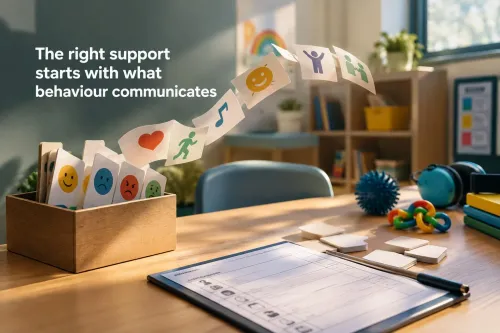


A special-school behaviour programme can support an autistic child when it starts with the child’s communication, sensory, learning and health needs rather than a generic promise of compliance. You will learn how to assess fit, recognise ethical practice, compare therapy roles and judge whether a programme is producing useful changes at school, home and in the community.
Key takeaways
- Choose therapy that targets participation, communication, safety, and daily independence.
- Ask how the programme handles consent, assent, distress, pain, and sensory overload.
- Require individual goals, baseline measures, progress reviews, and family feedback.
- Check staff training, supervision, safeguarding, communication, and school-home coordination.
When Is Special-School Behaviour Therapy a Good Fit?
Special-school behaviour therapy for children with autism is a good fit when an individualized plan improves the child’s participation and safety. Suitability depends on age, communication level, adaptive skills, learning profile, sensory needs, motivation, sleep, pain, anxiety, safety risks, and the situations in which behaviour occurs.
Behaviour therapy identifies what happens before and after a behaviour, works out its likely function, changes the environment, and teaches a replacement skill. It is not simply an attempt to suppress visible behaviour. A school team records the trigger, behaviour, consequence, frequency, duration and intensity before choosing an intervention.
| Trigger or pattern | Likely function | Useful response |
|---|---|---|
| Difficult task or transition | Escape | Adjust the task and teach “break” or “help” |
| Adult reaction | Attention | Teach an appropriate attention request |
| Blocked toy, food or activity | Obtain an object or activity | Teach requesting and waiting |
| Noise, movement or other sensory input | Sensory regulation | Offer suitable sensory support and a regulation strategy |
| Hitting, crying or withdrawal | Communicate discomfort | Check communication, pain and the environment |
A sudden escalation requires medical and mental-health review before adding sessions. Check for pain, constipation, poor sleep, epilepsy, anxiety and medication effects.
Special-school support is appropriate when it improves safe participation, communication, learning and independence through an individualized plan. The plan should work alongside education, speech-language therapy, occupational therapy, sensory support and medical care.
What Does an ABA-Informed School Programme Look Like?
ABA is a set of behavioural principles and procedures, not one fixed treatment package. Two programmes advertised as “ABA therapy autism Pune” can differ in goals, hours, prompting, communication methods and outcome measures. A school plan should explain what skill it teaches, why it matters and how progress will be recorded.
| Approach | Main role | How it may work with ABA |
|---|---|---|
| ABA-informed support | Teaches functional skills and changes learning conditions | Uses reinforcement, prompting and practice across settings |
| Special education | Teaches academic, classroom and adaptive skills | Embeds behavioural goals within the curriculum |
| Speech-language therapy | Develops speech, language and communication | Supplies communication systems and targets such as requesting |
| Occupational therapy and sensory support | Addresses motor, daily-living and sensory needs | Adjusts tasks, materials and regulation supports |
| Counselling | Supports emotional wellbeing and coping | Helps address anxiety, feelings and relationships |
A school programme may combine structured teaching, natural-environment teaching, visual schedules, task analysis, transition practice and functional communication training. Staff might teach a child to request a break instead of dropping to the floor, follow a two-step classroom routine, or move between activities when a visual timer ends.
They use prompts, then fade them, reinforce useful responses and practise skills with different classrooms, staff, family members and community routines. ABA does not replace education, communication therapy, sensory or daily-living support, counselling or medical care; these services work together when their goals and strategies are coordinated.
How Can You Tell Whether the Approach Is Ethical and Child-Centred?
A quality test is whether goals improve the child’s safe participation, communication or independence. Useful goals include requesting help, communicating pain, tolerating a transition, joining a peer activity, completing a classroom routine and learning toileting steps. “Becoming less autistic,” making eye contact on demand or appearing quiet are not ethical targets.
Positive reinforcement means identifying something the child values, delivering it immediately after the target response, then varying or gradually reducing it as the skill becomes reliable. Check that adults are not accidentally rewarding unsafe or disruptive behaviour by giving escape, attention or preferred items after it occurs.
Reinforcement must sit within a broader plan that adjusts task difficulty, provides communication access and respects sensory needs. A child can assent through words, gestures or active participation; turning away, covering ears, freezing, crying or escalating are observable distress signals that require a pause and review, not automatic demands.
Use this checklist when comparing autism behaviour support pune services:
- Ask whether the child’s dignity, privacy and right to communicate guide decisions.
- Treat punishment, forced compliance, routine restraint or seclusion, and withholding food, water, toilet access or breaks as serious warning signs.
- Reject repetitive drills without a functional goal and programmes that ignore distress.
- Ask how staff identify a valued reinforcer, teach a replacement skill and fade prompts or rewards.
- Check whether the plan measures meaningful participation across people and settings, rather than quietness alone.
- Ask what happens when a child refuses, becomes distressed or stops progressing.
What Should You Check Before Choosing a Pune Provider or School?
Turn “behaviour therapy for autism Pune” into a written comparison, not a choice based on online reviews. Ask who assesses the child, designs the plan and supervises staff; which recognised qualifications and professional registrations apply; and how many children each adult supports.
| Provider evidence | Ask to see | Warning sign |
|---|---|---|
| Assessment and goals | Sample observable goals, baseline data and the review interval | “Improvement” without a measurable target |
| Safety and consent | Safeguarding procedure, consent process, complaints route and session length | No named reporting process or routine forced compliance |
| Progress and staffing | Staff-to-child ratio, recording method and what changes when progress stalls | High hours, testimonials or a quiet classroom presented as proof |
Ask whether staff record frequency, duration, intensity or independence in a consistent format. Find out whether they change the task, communication method, prompt, reinforcement, environment or assessment when a target is not improving instead of automatically adding hours.
Check coordination with the child’s school, speech-language therapist, occupational therapist, doctor and family. Caregivers need coaching to use the same communication and reinforcement strategies at home; otherwise a skill may remain inside the therapy room.
For families near Sinhgad Road, Kothrud or nearby Pune schools, SAVI CHILD DEVELOPMENT AND RESEARCH CENTRE PVT LTD can be compared with other autism behaviour support Pune providers using these same questions about assessment, supervision, parent involvement and data sharing.
Choose the setting only if it provides an appropriate curriculum, communication access, safe participation and practice across school, home and community.
Related services
ABA Therapy Applied Behavior Analysis (ABA) Therapy is a personalized approach that helps children develop important communication, social, learning, and... View service → |
Special Education provides personalized learning and developmental support for children with different learning needs and abilities. View service → |
How Will You Know the Therapy Is Helping?
You know therapy is helping when the team can show a change in a functional skill, not just say that the child is “improving.” The plan should state a baseline, define the target response, and record frequency, duration, intensity or independence, as appropriate.
| Measure | Observable record | Evidence of progress |
|---|---|---|
| Requesting a break | Independent requests divided by total opportunities | Higher percentage without prompts |
| Transitions | Steps completed without unsafe behaviour | More steps completed safely |
| Tasks, toileting and peers | Tasks finished, toileting steps completed or peer activities joined | Greater independence across opportunities |
Data should identify who collected it, where it happened and which prompt was used. Review it at agreed intervals, such as every two to four weeks, during parent meetings; one successful session with one therapist is not enough.
Generalisation is essential. Practise the skill with teachers, parents, siblings and community adults in different rooms, routines and settings. If progress stalls, the team should decide what to change:
- simplify or rearrange the task
- change the communication method
- test a different reinforcer
- reduce, alter or fade prompts
- adjust the environment
- request a clinical assessment for pain, sleep, anxiety or another health issue
Do not automatically add therapy hours; extra hours can reduce rest, play and family participation. Special-school behaviour therapy can help when it produces functional, respectful gains alongside education, communication, occupational, medical and family support. It is not a cure for autism or a substitute for the child’s whole care plan.
Frequently asked questions
When is special-school behaviour therapy a good fit for a child with autism?
It is a good fit when an individualized plan improves participation and safety while addressing communication, adaptive skills, sensory needs, motivation, sleep, pain, anxiety, and the situations in which behaviour occurs.
What does an ABA-informed school programme look like?
It uses observable goals, structured teaching, reinforcement, functional behaviour assessment, data collection, communication supports, and regular review rather than relying on punishment or one fixed routine.
How can you tell whether autism behaviour therapy is ethical and child-centred?
Check whether staff respect communication, assent, sensory needs, dignity, and breaks; investigate pain and distress; explain goals clearly; and avoid restraint, forced compliance, or suppressing harmless autistic behaviour.
What should you check before choosing a Pune provider or school?
Ask about staff qualifications and supervision, assessment methods, safeguarding, group size, communication with families, therapy goals, school-home coordination, incident procedures, and how progress is reported.
How will you know whether the therapy is helping?
Look for measurable improvement across real settings, such as safer transitions, clearer communication, greater independence, better participation, and reduced distress, supported by baseline data and regular reviews.