
A child with autism does not need to speak before receiving communication support, and speech therapy is not limited to producing more words. By examining how your child understands, expresses, plays, interacts, and communicates across daily routines, you can decide whether speech-language therapy is appropriate and what to expect from a Pune provider.
Key takeaways
- Seek therapy when communication barriers affect safety, learning, participation, or relationships.
- Ask for a functional communication assessment, not only a speech-sound evaluation.
- Use gestures, picture cards, signs, or AAC when spoken language is limited.
- Track requests, responses, understanding, and participation between appointments.
Which communication signs suggest that speech therapy could help?
Assess speech therapy when communication barriers affect a child’s safety, participation, learning, or relationships. The concern is not whether speech sounds typical; it is whether the child can communicate reliably and be understood.
| Sign | What you may notice | Why assessment matters |
|---|---|---|
| Very limited or unclear speech | Few words, unintelligible speech, or difficulty expressing needs | The child may struggle to request help, report pain, refuse, or join activities |
| Understanding difficulty | Trouble following instructions, answering questions, or shifting between home and school | Receptive-language support can improve safety and learning |
| Unhelpful echolalia | Repeating phrases without using them to request, answer, refuse, or share an idea | Therapy can build more functional communication |
| Unreliable non-speaking communication | Pointing, pulling an adult, crying, or isolated gestures without a consistent system | Gestures, pictures, signs, or AAC can provide dependable alternatives |
| Social-communication difficulty | Trouble joining play, taking turns, using gestures, or sharing attention, even with sentences | Therapy can target conversation, play, joint attention, and relationships |
Autism speech therapy may address receptive and expressive language, speech sounds, social communication, voice, fluency, and functional communication. A child does not need to speak before starting.
Families considering speech therapy for children with autism in Pune can seek an assessment based on daily barriers, not a promise to make the child talk. Speech therapy for developmental delays can also begin before an autism diagnosis is confirmed when communication already disrupts daily life.
What happens during an assessment, and when is speech therapy the right first step?
The first appointment should test communication in real situations, not simply count words. The clinician should examine understanding, expressing needs, speech sounds, play, imitation, joint attention, gestures, social interaction, and communication at home and school.
Ask whether the assessment will observe your child requesting, commenting, choosing, refusing, answering, following a two-step instruction, and coping with transitions. Ask how hearing, vision, attention, sleep, motor development, oral-motor skills, feeding, and developmental history will affect the plan.
- Arrange an audiology referral if hearing has not been checked.
- Ask a paediatrician or developmental paediatrician to investigate broader concerns, including motor, attention, or developmental differences.
- Seek feeding and medical assessment for coughing, choking, wet breathing, weight loss, or prolonged mealtimes; routine speech goals alone are not enough.
| Concern | Useful next professional | When it applies |
|---|---|---|
| Hearing not checked | Audiologist | Hearing could be affecting language |
| Sensory or motor regulation | Occupational therapist | Regulation blocks participation |
| Learning, behaviour, or classroom access | Psychologist or special educator | School functioning needs support |
| Broader developmental concerns | Paediatrician or developmental paediatrician | Multiple areas are affected |
Speech therapy for developmental delays can begin before an autism diagnosis. Autism speech therapy is not always the first or only intervention, but it can run alongside these referrals. Before starting, ask for the assessment period, planning time, proposed frequency, session length, caregiver practice, and review date—not a fixed appointment package.
How can a child communicate when spoken language is limited?
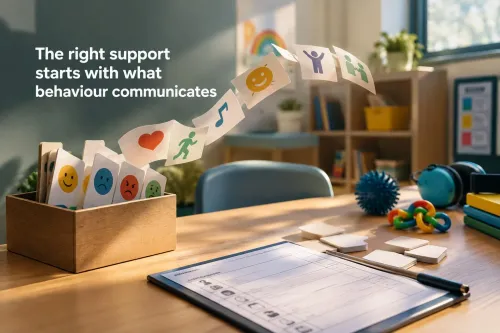
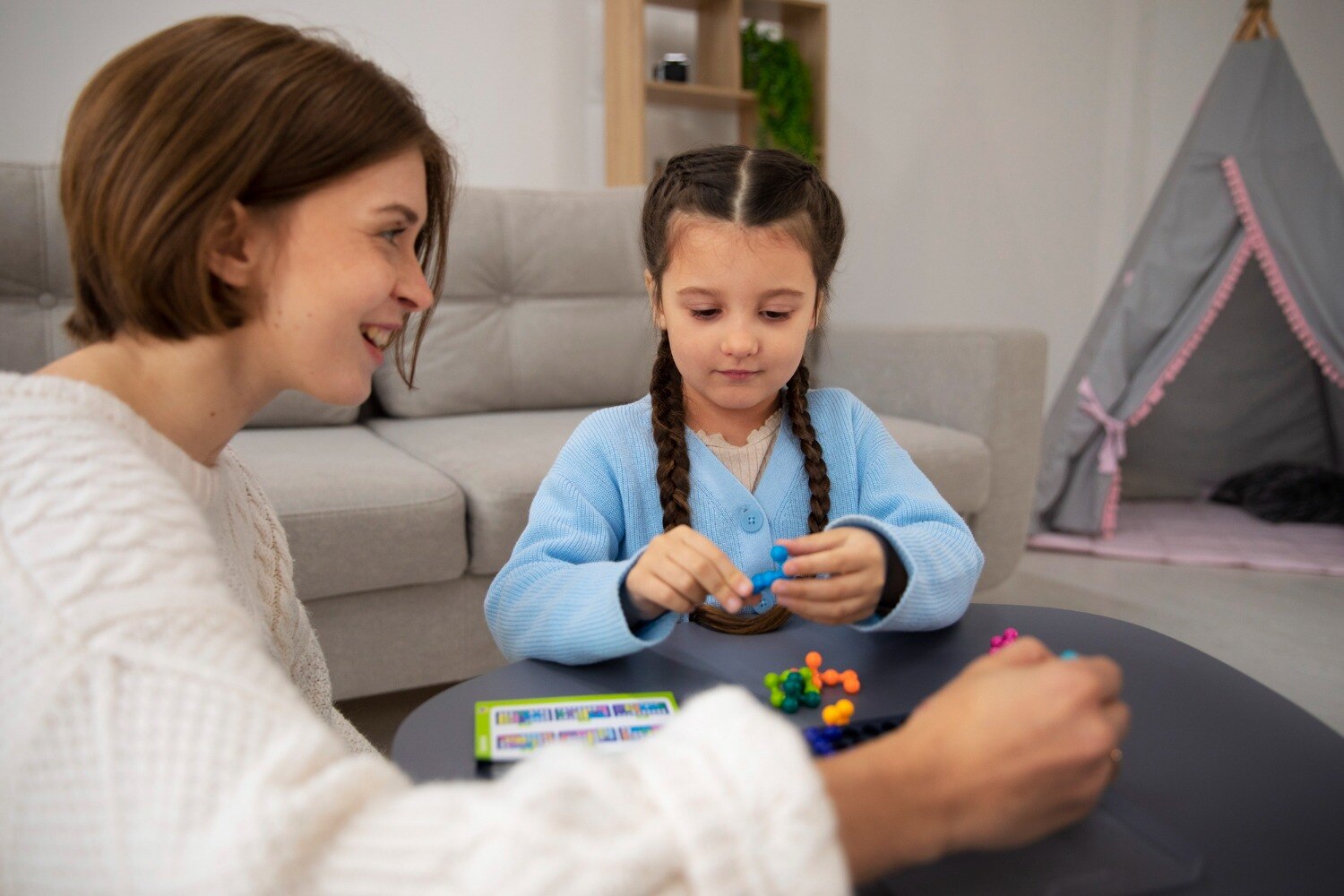
Spoken language is not a prerequisite for communication therapy for children. Autism speech therapy can use play-based interaction, imitation, modelling, visual supports, turn-taking, choice-making, and everyday routines instead of isolated word drills.
A therapist might place two objects in view and model a request, pause during a familiar game to invite a turn, show a picture sequence for washing hands, or practise “what” and “where” questions during play. Children can communicate through:
- Gestures, photographs, picture symbols, or communication boards
- Sign language
- A speech-generating device
These supports are called augmentative and alternative communication, or AAC. Ask the clinician to trial a system the child can access at home, school, and outdoors, then teach every regular communication partner how to respond.
| Option | What it supports | Example |
|---|---|---|
| Gestures or signs | Immediate functional messages | Pointing, waving, rejecting |
| Pictures or symbols | Choosing and requesting | Selecting a snack or toy |
| Communication board | Multiple messages in one place | Help, pain, finished, more |
| Speech-generating device | Spoken output through selected symbols or words | Commenting or answering |
AAC does not prevent speech development. It gives your child a dependable way to request help, indicate pain, reject an activity, comment, choose, and participate while speech develops when useful. Waiting for speech can increase frustration.
In multilingual Pune households, support Marathi, Hindi, English, or another home language according to the family’s real use. Families searching for speech therapy Pune services should ask whether the clinician supports those languages rather than advising you to stop using your strongest one.
How should you measure progress between appointments?
Measure progress by what your child does in daily life, not by how many words they repeat in therapy. Write goals as observable actions, such as asking for help during dressing, indicating pain, refusing safely, following a two-step instruction, joining a peer activity, choosing a meal item, or communicating at the table.
- Track spontaneous communication, comprehension, reliable AAC use, longer turn-taking, clearer speech, and fewer communication-related distress episodes.
- Check whether the skill works with parents, siblings, teachers, and peers—not only with the therapist. Ask when and how it will be tested across people, places, and routines.
- Create brief opportunities during meals, dressing, play, travel, and school preparation: offer two choices, pause before giving a wanted item, model one useful word or symbol, honour refusal, and respond to every intentional attempt.
- Ask for a simple home plan, written measures, and review dates. Do not turn every interaction into a test.
| Measure | Useful evidence | Warning sign |
|---|---|---|
| Functional communication | The child requests, refuses, comments, or indicates pain | Communication works only during drills |
| Generalisation | The skill appears at home, school, and in the community | A new clinic skill does not transfer |
| Participation | Fewer distress episodes and better joining, understanding, or turn-taking | More words but no daily benefit |
For communication therapy for children, consistency between visits matters more than buying a large package of sessions. Frequency depends on goals, availability, tolerance, travel, and family capacity. A speech therapy for children with autism Pune provider, school team, occupational therapist, ABA practitioner, special educator, and family should use compatible communication responses.
How can Pune families choose a speech-therapy service that fits?
Choose a provider by evidence of fit, not by location or a promised method. For speech therapy Pune families, ask whether a licensed speech-language professional assesses autistic children, understands AAC, and works in Marathi, Hindi, English, or your home language. Request examples of written goals and progress measures.
- Ask how individual sessions differ from group sessions, how long appointments last, when reviews occur, and how the therapist coordinates with school, occupational therapy, psychology, paediatrics, and special education.
- Check travel time from home or school, appointment availability, and whether the same therapist will continue. Teletherapy is not realistic for every child when attention, physical access, feeding, or device setup requires hands-on help.
- Request a written summary covering findings, functional goals, home practice, communication systems, and review measures.
| Option | What to check | Main limitation |
|---|---|---|
| Individual sessions | Personalised goals and direct caregiver coaching | Less peer practice |
| Group sessions | Turn-taking, participation, and social communication | Goals may be less individualised |
| Teletherapy | Internet, device access, adult support, and suitable activities | Cannot replace hands-on support for every child |
During an observation, notice whether the therapist follows the child’s interests, accepts gestures and AAC, adapts the plan, and includes caregivers. Speech therapy for children with autism Pune families consider should not promise speech, rapid results, or one method for every child. Question therapy that suppresses harmless autistic communication.
Families comparing SAVI CHILD DEVELOPMENT AND RESEARCH CENTRE PVT LTD on Sinhgad Road can apply these questions before choosing. The right service improves access, participation, and understanding—not compliance for its own sake.
Related service
Speech Therapy At Savi ChildCare, our specialized Speech Therapy services help children develop effective communication and language skills in a supportive,... View service → |
Frequently asked questions
Which communication signs suggest that speech therapy could help an autistic child?
Speech therapy could help when a child cannot reliably express needs, understand instructions, respond to others, take turns, use gestures, or communicate safely in daily situations.
What happens during a speech and language assessment?
The therapist observes understanding, gestures, play, social interaction, speech sounds, communication attempts, and daily needs, then recommends goals and suitable support.
Is speech therapy the right first step for every autistic child?
It is a strong first step when communication barriers affect safety, learning, participation, or relationships. The assessment can also identify when another professional or a combined service is needed.
How can a child communicate when spoken language is limited?
A child can use gestures, objects, signs, picture boards, communication books, or an augmentative and alternative communication device alongside spoken-language work.
How should parents measure speech therapy progress between appointments?
Record how often the child communicates, what they communicate, how much prompting they need, how well others understand them, and whether communication improves daily participation.