

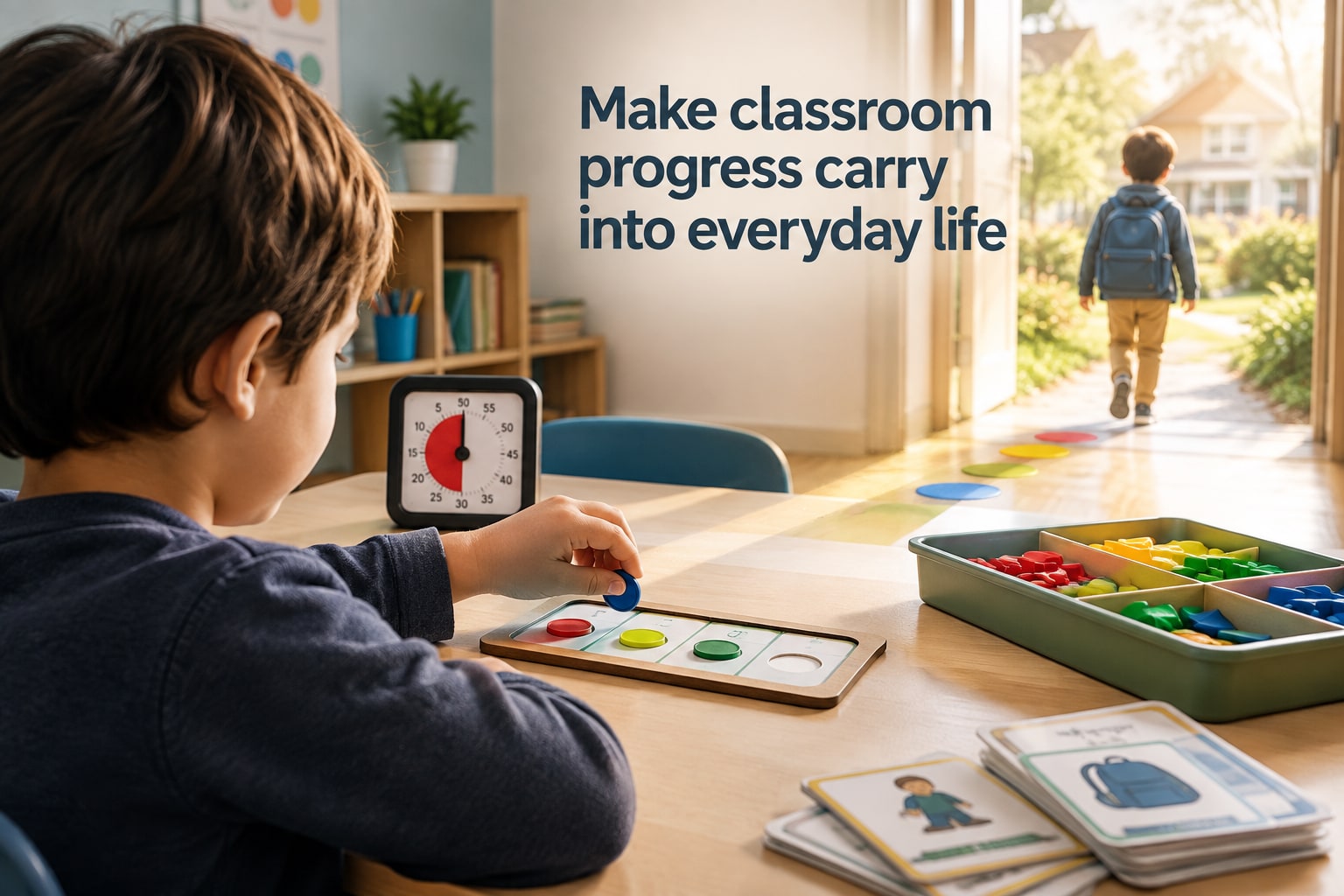
A child who struggles with transitions, communication, group activities or unsafe behaviour needs more than a label such as “naughty” or “non-compliant.” You will learn how ABA and behaviour therapy work in a special-school setting, how to measure meaningful progress, and how to choose the right combination of support in Pune.
Key takeaways
- Choose goals such as requesting help, transitions, toileting or group participation.
- Ask for observable targets, baseline data, prompting plans and a review date.
- Practise skills in classrooms, homes and community settings so progress carries over.
- Seek medical, educational and therapeutic assessment when behaviour disrupts learning or safety.
What ABA Means in a Special-School Setting
ABA is not one packaged treatment. In a special-school setting, it applies behavioural principles such as functional communication training, prompting, shaping, task analysis, reinforcement and naturalistic teaching to useful goals: requesting help, following a visual schedule, transitioning, toileting or joining group work.
The programme should build communication and functional independence, not make a child “normal,” “obedient” or less autistic.
ABA is different from classroom teaching, which manages group learning; special education, which adapts curriculum and instruction; speech therapy, which targets communication; occupational therapy, which addresses motor, self-care and participation skills; and sensory support, which helps a child regulate responses to sensory demands.
Behaviour therapy is a wider label that may address anxiety, emotional regulation, sleep, toileting, aggression, attention or parent–child interaction. It does not automatically mean autism-focused ABA, and ABA does not automatically provide CBT or other mental-health treatment.
Before choosing a service, check whether it offers:
- Observable goals and baseline data rather than labels such as “naughty” or “defiant”
- Individualised use of prompts, reinforcement and prompt-fading, not one fixed package
- Practice with teachers and caregivers so skills transfer beyond the therapy room
- Respect for communication, assent, dignity and the least-restrictive approach
- Coordination with speech, occupational, educational, medical and mental-health professionals when needed
Families searching “aba therapy special school behaviour therapy near me” or “special school behaviour therapy pune” are using location-and-service phrases, not quality indicators. Compare assessment methods, staff qualifications, written goals, data sharing and school coordination.
How a Behaviour Plan Turns Classroom Problems into Measurable Goals
Choose one observable target, not a label such as “defiant.” A useful definition is: “leaves the chair for more than three seconds during group work.” The plan then shows what happens before, during and after that behaviour.
1. Record a baseline before teaching begins: how often the child leaves, how long each episode lasts, and in which activities. Add the measurement method and a review date.
2. Complete a functional assessment using the pattern “antecedent, behaviour, consequence.” The likely function may be escaping a difficult task, obtaining adult attention, gaining an item, or meeting a sensory need. The same behaviour can have different functions in different situations.
3. Break the replacement skill into teachable steps. For requesting help, steps might be orienting to the adult, selecting a picture or AAC button, and waiting for assistance. Use a prompt, reinforce the response immediately, then fade the prompt from physical guidance to gesture, visual cue and independence.
4. Define positive reinforcement precisely: after the desired response, provide something that increases that response, such as praise, access to an activity or a break. That differs from bribery offered before compliance, punishment that adds an unpleasant consequence or removes something, a delayed reward disconnected from the response, and forcing performance.
5. Measure progress with frequency, duration, latency, percentage of opportunities and independent steps completed. Review sleep, pain, constipation, seizures, medication changes and communication demands before changing the plan.
Ask about assent, dignity, least-restrictive practice, restraint, humiliation, forced eye contact, food deprivation and other aversive procedures. A refusal to explain methods is a warning sign.
Which School Skills Should Therapy Practise and How Does Progress Carry Over?
Practise functional school skills, not just responses that look successful in a therapy room. Useful targets include:
| Skill | Practice target | Carry-over check |
|---|---|---|
| Requesting help | Speech, signs, pictures or an AAC device | Uses the same method with a teacher and parent |
| Waiting | Waits for a turn or short delay | Waits with peers, not only the therapist |
| Following a visual schedule | Checks the next activity | Uses it in class and at home |
| Transitions | Moves safely between activities | Responds to a warning and changes location |
| Participation | Remains seated and joins group work | Stays engaged with different materials |
| Self-care | Completes toileting steps | Follows the sequence in the school bathroom |
| Safety | Responds when a preferred item is unavailable | Uses “no,” “help” or “later” instead of unsafe behaviour |
A learned skill does not automatically transfer to a classroom, playground or home. Parents and teachers should share the target definition, prompt hierarchy, communication supports, reinforcement plan, transition warning and data sheet.
Coach caregivers and teachers directly, practise with different people and materials, and fade prompts systematically so the child does not perform only for one therapist.
More ABA hours are not automatically better. Set intensity around age, communication, adaptive skills, health, school demands, family capacity, response and distress; review poor fit instead of simply adding sessions.
- Triggers and early warning signs
- Supports that worked
- Unsafe behaviour and immediate safety steps
- Recent sleep, pain, constipation, seizure, medication or communication changes
- Data and next review date
When Behaviour Calls for Medical, Educational or Therapeutic Assessment
Aggression, self-injury, withdrawal or sudden skill loss are reasons to investigate, not automatic instructions to discipline or start behaviour modification. Ask a clinician to check pain, gastrointestinal illness or constipation, poor sleep, hunger, hearing or vision problems, epilepsy, medication effects, anxiety, sensory overload, bullying, communication frustration and excessive classroom demands.
- Communication breakdown: request speech-language and AAC assessment.
- Motor, dressing, feeding or sensory difficulties: request occupational therapy and sensory support.
- Trouble accessing lessons: request special education assessment and classroom adaptations.
- Anxiety or emotional distress: involve qualified mental-health care. Behaviour therapy is broader than ABA and does not automatically provide CBT.
- Skill acquisition or safety patterns: consider behaviour analysis, including ABA, with observable goals and data.
- Overlapping needs: combine services instead of asking one provider to address every domain.
ABA is not a cure for autism and does not replace developmental assessment, medical care, suitable education, speech-language therapy, occupational therapy or mental-health support. Searches such as aba therapy for autism pune or child behaviour therapy near me identify services, not quality.
Choose a plan that prioritises communication, safety, participation and independence, then reassess when behaviour changes suddenly.
How to Compare ABA and Behaviour Therapy Services in Pune
Compare providers on evidence, credentials and safeguards, not on a search result for “aba therapy in wanowrie.” Use this comparison:
| Option | What to compare | Warning sign |
|---|---|---|
| ABA service | Functional assessment, measurable skill targets and data-based reviews | “One method fits every child” |
| Broader behaviour therapy | Support for anxiety, sleep, toileting, emotional regulation or family interaction | Claims that every concern needs ABA |
| School-linked service | Observation, teacher coordination and practice across classroom, home and playground | Progress reported only from the therapy room |
Ask each provider:
- Who completes the functional assessment, who supervises the programme, and what training and safeguarding experience does each professional have?
- If an RCI-covered rehabilitation professional is involved, can they provide their professional category and Certificate of Registration number for verification through the RCI system?
- Can you receive written goals, baseline measures, review dates, sample progress reports, fees, waiting time, school-observation arrangements and a caregiver-coaching plan covering generalisation?
- Does the service use punishment, humiliation, forced eye contact, food deprivation, unnecessary restraint or any other aversive procedure? Ask for its consent or assent policy and adverse-event reporting process.
SAVI CHILD DEVELOPMENT AND RESEARCH CENTRE PVT LTD in Wanoworie can be one local option for coordinated child-development support, but choose based on assessment quality, staff credentials, school coordination, data sharing and your child’s comfort—not proximity or ranking. A refusal to answer these questions is itself useful information.
Related service
ABA Therapy Applied Behavior Analysis (ABA) Therapy is a personalized approach that helps children develop important communication, social, learning, and... View service → |
Frequently asked questions
What does ABA mean in a special-school setting?
ABA applies behavioural principles to practical school goals, including functional communication, visual schedules, transitions, toileting, task completion and group participation. Common methods include prompting, shaping, task analysis, reinforcement and naturalistic teaching.
How does a behaviour plan make classroom problems measurable?
A plan defines the behaviour in observable terms, records a baseline, identifies triggers and consequences, then sets a target such as fewer incidents, faster transitions or more independent requests. It also specifies teaching strategies, data collection and a review date.
Which school skills should ABA or behaviour therapy practise?
Prioritise skills that affect independence and participation: communicating needs, following instructions, starting and finishing tasks, waiting, transitioning, self-care, play and group work. Teachers and therapists should practise the same response across settings so the child can use it beyond one session.
When does behaviour require medical, educational or therapeutic assessment?
Request assessment when behaviour changes suddenly, causes injury, disrupts education, signals pain or sleep problems, or does not improve with a consistent plan. Medical assessment can check health factors, educational assessment can identify learning and classroom needs, and therapeutic assessment can examine communication, sensory, emotional and daily-living skills.
How can families compare ABA and behaviour therapy services in Pune?
Ask each provider how they assess the child, define goals, collect data, involve teachers and parents, train caregivers, and measure carry-over across settings. Confirm session structure, qualifications, supervision, communication with school staff and how the plan changes when progress stalls.