
A child can have the strength to perform a task yet struggle to dress, eat, write, sleep, play or take part in class. By the end, you will know what paediatric occupational therapy addresses, which everyday signs justify an assessment, what to ask a provider, and how to judge whether support is improving participation at home, school and in the community.
Key takeaways
- Therapy targets participation in home, school and community routines.
- Ask for assessment when functional difficulties limit daily activities.
- The first assessment should examine real tasks across home and school.
- Track progress by what your child does more independently in daily life.
What Occupational Therapy Changes in a Child’s Daily Life
Occupational therapy changes the target from an isolated skill to participation: what your child can do at home, school and in the community. The therapist links body control, sensory processing, attention, coordination or planning to a real task, then adjusts the task, environment or support.
The occupational therapy for children in Pune everyday benefits are therefore functional goals, not guaranteed milestones.
A plan might aim for your child to:
- Use a spoon with less spilling
- Tolerate tooth-brushing
- Dress by finding armholes and fastening clothing
- Remain seated for a classroom activity
- Join playground play or complete a morning routine with fewer prompts
Progress is easier to see when “better motor skills” becomes an observable step, such as pulling a shirt over the head or recognising when help is needed. These child occupational therapy benefits depend on the child’s age, routines, developmental profile and priorities at home and school.
Therapy differs by its main question:
| Approach | Main question |
|---|---|
| Occupational therapy | What support helps the child complete a daily activity? |
| Physiotherapy | How can strength, balance, mobility or movement improve? |
| Speech-language therapy | How can the child communicate, understand language or manage swallowing? |
| Special education | What teaching method helps the child learn academic and functional content? |
| Counselling | How can emotions, behaviour or relationships be understood and supported? |
A child may need more than one service. Occupational therapy supports participation; it does not replace medical, hearing, vision, speech, psychological or educational assessment when those needs are present.
From Dressing to Schoolwork: The Activities Therapy Can Target
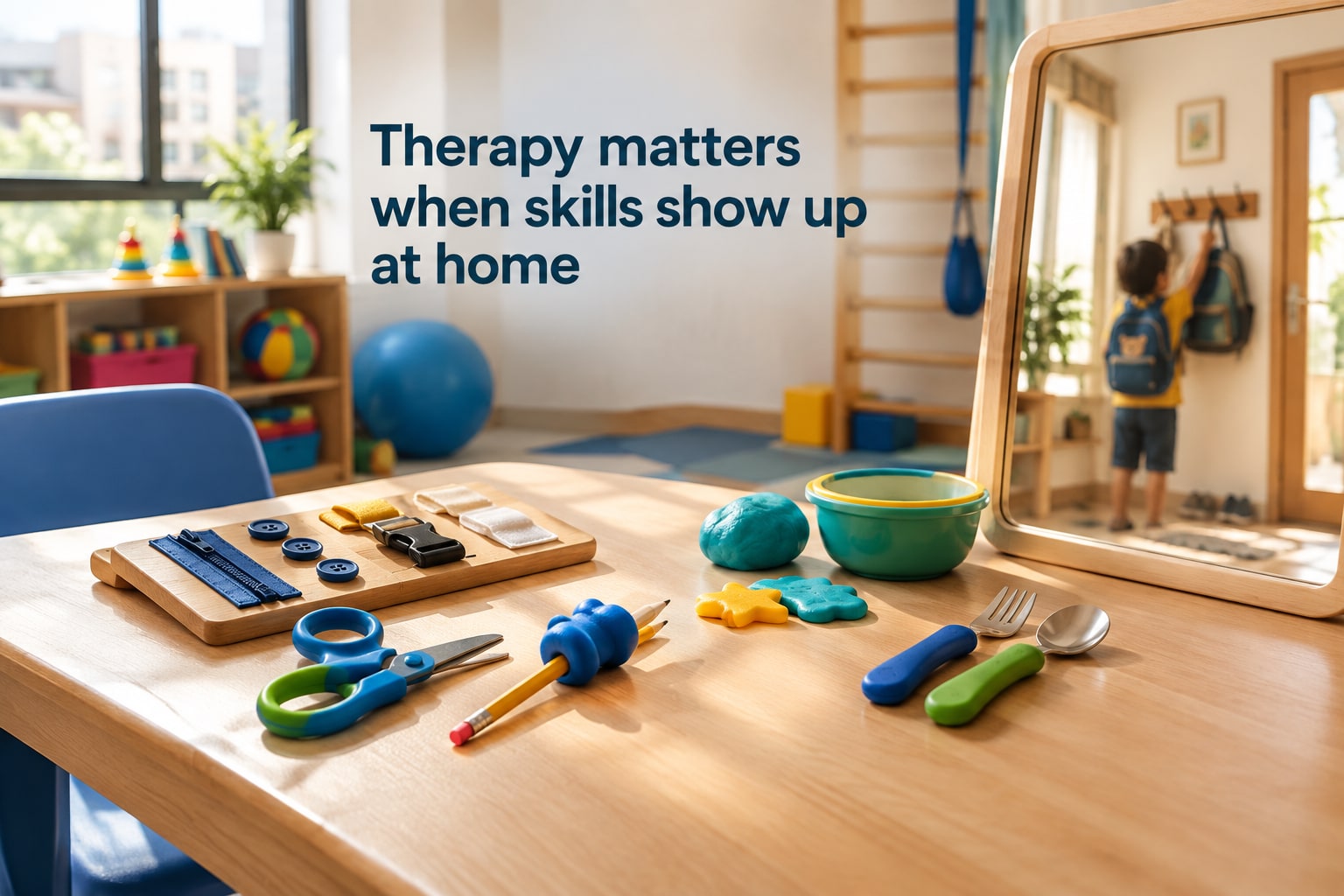
A therapist practises the activity that is difficult, not just an isolated skill. These occupational therapy daily activities are broken into observable steps, so “dressing independently” becomes orienting a shirt, finding armholes, pulling it over the head, fastening it and asking for help when needed.
| Activity | What may be practised | How the therapist adapts it |
|---|---|---|
| Dressing | Shirts, trousers, socks, buttons and zips | Starts with loose clothing or large fasteners, uses a dressing board, then reduces prompts |
| Eating | Scooping, piercing food, drinking and using both hands | Changes utensil size, plate position, food texture or hand-over-hand assistance |
| Toileting and bathing | Clothing management, wiping, washing and sequencing | Uses a visual schedule, stable seating, non-slip supports and graded help |
| Brushing teeth | Holding the brush, reaching each area and tolerating toothpaste | Adjusts brush type, timing, mirror use and sensory exposure |
| Handwriting and schoolwork | Pencil control, letter formation, cutting and copying | Changes pencil grip, paper angle, writing amount, spacing or response method |
| Classroom routines | Sitting, shifting tasks, organising materials and following instructions | Uses a checklist, colour-coded folders, movement breaks or a quieter seat |
| Play and playground skills | Climbing, ball games, turn-taking and bilateral coordination | Grades obstacle courses, equipment size, speed, rules and social demands |
The plan reflects the child’s age, strengths, communication, routines and priorities at home and school. A therapist might practise packing one schoolbook before adding the full bag, or begin toothbrushing for ten seconds before extending the time.
Parents and teachers need specific instructions: the activity, the amount of help, safety limits and the sign of progress. A sensory strategy matters only if it helps the child complete a meaningful task.
When a Functional Difficulty Deserves an Assessment
A child may benefit from an assessment when an everyday task repeatedly takes far more effort than expected for their age, causes distress, or requires extensive adult help.
The trigger is participation—not a diagnosis: difficulty dressing, eating, toileting, play, classroom work, sleep routines, or joining peers is enough to ask what is getting in the way.
Look for patterns such as:
- Frequent falls, bumping into objects, trouble using both hands together, or difficulty managing scissors, pencils, buttons, or cutlery.
- Strong distress during tooth-brushing, bathing, haircuts, clothing changes, noisy rooms, messy foods, or movement activities.
- Trouble starting, sequencing, or finishing a morning routine without repeated prompts.
- Avoiding playground equipment, crafts, handwriting, construction toys, or games that require motor planning.
- Fatigue, poor sitting tolerance, lost school materials, or work that takes much longer than classmates’ tasks.
- Difficulty shifting between activities, coping with unexpected changes, or staying involved in group play.
Understanding child occupational therapy benefits starts with linking the observed difficulty to a specific task and setting.
An assessment should consider vision and hearing, movement, communication, attention, sleep, emotional factors, learning, and the home or classroom environment; occupational therapy is not a substitute for medical, speech-language, physiotherapy, psychological, or special-education support when those needs are present.
Ask for goals you can observe, such as fastening one button, tolerating tooth-brushing for two minutes, or completing a school task with fewer prompts. The plan should match the child’s age, profile, routines, and family priorities rather than assume that one diagnosis or sensory strategy fits every child.
What the First Assessment Should Cover—and What to Ask in Pune
Expect the first assessment to connect a child’s skills with real activities, not just produce scores. The therapist should ask about dressing, eating, toileting, sleep, play, schoolwork, transitions and sensory demands; observe relevant tasks; review medical, developmental and school information; and identify environmental barriers.
Ask for two or three written goals, such as “uses a spoon for five bites” or “starts a worksheet with one prompt,” rather than “improves fine-motor skills.”
Ask these questions before choosing a provider:
- Which daily activities will you assess, and will you observe the child at home or school when needed?
- How will you adapt goals to the child’s age, routines, diagnosis or developmental profile, and family priorities?
- How will you involve caregivers and teachers, and what home practice will you demonstrate?
- If you use sensory-based strategies, which functional goal will each strategy serve, and how will you measure benefit?
- When will you review the plan, and what happens if progress stalls or another evaluation is needed?
A search for “occupational therapy children pune” or “occupational therapy wanowrie” creates a shortlist, not proof of quality. Compare providers using the same questions.
| Compare | Ask for | Warning sign |
|---|---|---|
| Assessment | Activities observed and information collected | Only a generic checklist or diagnosis-based package |
| Goals | Observable task, assistance level and review date | “Overall development” without a measurable action |
| Participation | Caregiver and teacher communication | Therapy kept separate from daily routines |
| Coordination | Referral or collaboration with speech, physiotherapy, psychology, special education, or hearing and vision services | Claims that occupational therapy replaces other care |
| Practical fit | Travel time, session frequency, fees, cancellations and caregiver training | A plan your family cannot maintain |
If you contact SAVI CHILD DEVELOPMENT AND RESEARCH CENTRE PVT LTD, use this checklist to ask how its assessment findings become home and school goals rather than choosing on Wanowrie location alone.
Related service
Occupational Therapy For Children In Pune Occupational Therapy For Children In Pune Occupational therapy plays a crucial role in helping children with special needs, particularly those diagnosed with autism, achieve greater... View service → |
How to Tell Whether Therapy Is Carrying Over Into Real Life
Judge occupational therapy for children in Pune by its everyday benefits, not by clinic exercises or a diagnosis label. Choose one priority, such as using a spoon, tolerating tooth-brushing, fastening a shirt, or completing a morning routine with fewer prompts, and describe success in observable terms.
1. Write the starting point: “needs four prompts to put on a shirt” is clearer than “poor motor skills.” Break the task into steps, such as finding armholes, pulling fabric over the head and fastening closures.
2. Agree on the same measure across settings. Record prompts, time, completed steps, refusals, or assistance level at home and school. A teacher might track whether the child remains seated for eight minutes; a parent might record tooth-brushing tolerance.
3. Give caregivers and teachers one practical strategy to use in the routine, with the exact amount of help, safety limits, and a method for recording results. Practice should fit ordinary life, not depend only on clinic sessions.
4. Review the data at an agreed date, such as four to six weeks. Keep the plan when participation improves, change the strategy when progress stalls, and reassess the goal when it no longer matters to the child or family.
Frequency and session length should follow goals, fatigue, school demands, family capacity, and response—not a standard package. Occupational therapy daily activities are useful targets only when the child can use the new skill beyond the therapy room.
Frequently asked questions
What does occupational therapy change in a child’s daily life?
It connects skills such as coordination, sensory processing, attention and planning to practical participation at home, school and in the community.
Which daily activities can child occupational therapy target?
Therapy can target dressing, eating, toileting, handwriting, classroom tasks, play, self-care and other routines that are difficult for the child.
When does a functional difficulty deserve an occupational therapy assessment?
Seek an assessment when a difficulty repeatedly limits independence, causes distress, takes much longer than expected or interferes with school, home or community participation.
What should a first occupational therapy assessment cover in Pune?
Ask the therapist to observe relevant tasks, discuss routines across settings, identify barriers and explain measurable goals, recommended support and how progress will be reviewed.
How can parents tell whether therapy is carrying over into real life?
Track whether your child completes everyday tasks with less help, fewer prompts, less distress or improved consistency outside therapy sessions.