
A child who struggles at school may need reading instruction, language support, hearing evaluation, developmental assessment, or a combination of services—not a generic therapy package. By comparing the roles, warning signs, assessment process, and measurable goals, you can choose the right starting point and avoid treating the wrong problem.
Key takeaways
- Speech therapy targets communication; special education targets academic learning.
- Ask for an assessment when communication, reading, writing, or classroom difficulties persist.
- A speech-language pathologist assesses communication; a special educator assesses learning and academic skills.
- Track specific goals and review progress with measurable changes every few weeks.
Special Education or Speech Therapy: Which Problem Are You Treating?
The problem determines the service: speech-language therapy targets communication, while special education targets academic learning. Special education or speech therapy for learning needs is not an either-or decision; a child may need one, both, or neither.
| Service | Main targets | Example need |
|---|---|---|
| Speech-language pathologist | Speech sounds; understanding and using language; vocabulary; grammar; conversation; fluency; social communication; augmentative or alternative communication when indicated | Developmental language disorder or unclear speech |
| Special educator | Phonological awareness; decoding; reading fluency; spelling; writing; mathematics | Dyslexia or persistent academic skill gaps |
| Both | Coordinated communication and academic instruction | Dyslexia with language difficulties |
| Neither first | Medical or sensory assessment | Unexplained hearing difficulty, vision problems, developmental regression, or broad developmental concern |
A child with dyslexia needs explicit, systematic literacy teaching. Speech therapy alone cannot replace instruction in decoding, spelling, reading fluency, or mathematics. A child with developmental language disorder may need language therapy; a child with both conditions needs coordinated services.
Accommodations provide access but do not teach the missing skill. Extra time, oral instructions, reduced copying, assistive technology, and a quieter seat help a child show learning, while remediation directly teaches decoding, grammar, spelling, or mathematical reasoning. Effective learning difficulties support may require both.
Arrange hearing or vision assessment first when those concerns are unexplained. Loss of acquired speech, language, motor, or social skills also requires prompt medical and developmental assessment.
Which Signs Justify an Assessment?
Seek an assessment when a child’s difficulties persist across home or school instead of waiting for catch-up. Arrange one if the child:
- Struggles with one-step or multi-step instructions, remembers spoken information poorly, or responds inconsistently to language.
- Uses few words, has unclear speech beyond expected milestones, or cannot explain needs clearly.
- Cannot identify, blend, segment, or manipulate sounds in words.
- Continues to struggle with reading and spelling, writes very slowly, or avoids classroom work.
- Shows weak working memory that affects following lessons, copying, or completing tasks.
“Learning difficulties” describes a concern, not a diagnosis. The cause may be dyslexia, dyscalculia, developmental language disorder, ADHD, hearing loss, intellectual disability, or more than one condition.
| Possible explanation | What assessment must examine |
|---|---|
| Dyslexia or dyscalculia | Phonological skills, decoding, spelling, number concepts, and calculation |
| Developmental language disorder | Understanding and using vocabulary, grammar, narratives, and classroom language |
| Hearing loss | Audiological access to speech sounds and spoken instructions |
| ADHD or intellectual disability | Attention, memory, reasoning, adaptive skills, and learning across settings |
Normal intelligence and normal hearing do not rule out language-related literacy problems. Vocabulary, grammar, narrative, or phonological weaknesses can still affect reading and writing.
Act promptly after loss of speech, language, motor, or social skills; failure to respond to sound; or inability to communicate basic needs. Multilingualism does not cause a language disorder. Assessment must include Marathi, Hindi, English, or every language the child uses, rather than judging ability from English exposure alone.
This evidence guides therapy for children with learning difficulties and practical learning difficulties support.
Who Should Assess the Child First?
Start with the professional who matches the clearest difficulty: a speech-language pathologist for communication, a special educator for academic skills, or a developmental pediatrician for broad developmental concerns, regression, or several affected areas. A hearing check comes first when speech is delayed or unclear, responses are inconsistent, or spoken instructions are hard to follow.
Arrange a vision check when reading, copying, or visual attention is affected.
| Professional | Main role | Best first contact |
|---|---|---|
| Speech-language pathologist | Speech sounds, fluency, receptive and expressive language, social communication | Unclear speech or language difficulty |
| Special educator | Phonological awareness, reading, spelling, writing, mathematics, classroom independence | Persistent academic difficulty |
| Developmental pediatrician | Medical and developmental review; referrals | Broad concerns or lost skills |
| Psychologist | Cognitive, learning, attention, and emotional assessment | Complex learning profile |
| Audiologist | Hearing evaluation | Delayed speech or inconsistent response to sound |
| Occupational therapist | Fine-motor, sensory, visual-motor, and daily-living skills | Writing, regulation, or classroom participation problems |
| School support team | Teacher evidence, curriculum planning, accommodations, progress monitoring | School-based concerns |
A proper assessment includes a caregiver interview; developmental, medical, and school history; hearing and vision information; language samples; speech-sound and fluency testing; receptive and expressive language tasks; phonological-awareness and literacy tasks; functional observation; notebooks, tests, teacher reports; and curriculum-based academic assessment. One IQ or school test cannot explain the whole picture.
The goal is a measurable target, not the broad label learning needs: following three-step directions, producing one sound, decoding unfamiliar words, spelling patterns, reading fluency, or independent classroom work. Whether you seek special education or speech therapy for learning needs, a search for speech therapy pune should lead to this full assessment process.
What Happens in Speech Therapy and Special Education Sessions?
After assessment, sessions should target named skills, use activities matched to the child’s profile, and record change over time. Therapy for children with learning difficulties is not a generic set of games; special education or speech therapy for learning needs must connect to functional communication, literacy, or classroom goals.
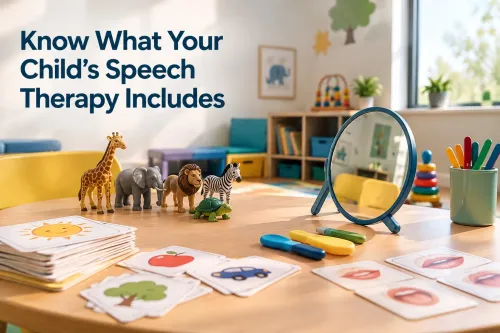
1. A speech-language pathologist may work on speech sounds, receptive language, expressive language, vocabulary, grammar, narrative, conversation, fluency, social communication, or augmentative and alternative communication when indicated. Speech-sound practice is different from oral-motor or Oral Placement Therapy.
Use oral-motor exercises when weakness, reduced awareness, or poor coordination of oral muscles contributes to the problem—not as default treatment for every unclear speech pattern.
2. A special educator teaching dyslexia-related reading difficulties should use explicit, systematic instruction in phonological awareness, sound-symbol relationships, decoding, spelling, fluency, vocabulary, and comprehension. Brain-training activities, unsystematic worksheets, or speech-sound drills alone do not teach the complete reading process.
3. Ask how progress will be recorded: correct sound production, responses to multi-step directions, unfamiliar-word decoding, spelling, reading accuracy and rate, or independent classroom work. Ask how home and school practice will work and when the plan will be reviewed.
4. Parent coaching should include waiting for responses, modelling slightly richer language, and practising through books and daily routines. Without this carryover, a skill used in therapy may not appear at home or school.
How to Choose a Service and Check Whether It Is Working
Searches for special education Pune or speech therapy Pune should start with the individual practitioner, not the centre’s label. Verify the practitioner’s qualification, registration, and scope of practice. When applicable, ask for Rehabilitation Council of India Central Rehabilitation Register details and confirm that the proposed service fits the child’s assessed need.
| Check | Strong evidence | Warning sign |
|---|---|---|
| Practitioner | Named qualification, registration, and defined role | Centre label without practitioner details |
| Assessment | Documented error pattern, baseline, and functional impact | Package selected before assessment |
| Intervention | Specific method linked to the target skill | Vague “development” activities |
| Review | Written measures and a dated review point | Improvement promised without evidence |
Ask every provider:
- What will you measure: correct sound production, multi-step directions, unfamiliar-word decoding, spelling, reading rate and accuracy, language-sample changes, or independent classroom work?
- How often will you record progress and revise the plan?
- What practice is expected at home and school?
- How will you coordinate goals with teachers, a speech-language pathologist, or other clinicians?
A multidisciplinary centre such as SAVI CHILD DEVELOPMENT AND RESEARCH CENTRE PVT LTD may help when a child needs coordinated special education, speech-language, developmental, or daily-living support. The plan must still follow documented assessment findings.
Choose the professional who can name the target skill, baseline, intervention method, and review date; learning difficulties support without those details is difficult to judge.
Related services
Special Education provides personalized learning and developmental support for children with different learning needs and abilities. View service → |
Speech Therapy At Savi ChildCare, our specialized Speech Therapy services help children develop effective communication and language skills in a supportive,... View service → |
Frequently asked questions
Should my child receive special education or speech therapy for learning needs?
Choose based on the difficulty being treated. Speech therapy addresses speech, language, listening, and communication; special education addresses academic skills and learning strategies. A child may need both.
Which signs justify an assessment?
Request an assessment when your child has persistent difficulty understanding instructions, expressing ideas, speaking clearly, learning sounds and letters, reading, spelling, writing, mathematics, or completing classroom tasks.
Who should assess my child first?
A speech-language pathologist should assess communication concerns. A special educator should assess academic learning concerns. Start with the professional matching the clearest difficulty, then coordinate further assessment when needed.
How can you tell whether therapy or special education is working?
Ask for written goals, baseline performance, session frequency, and review dates. Progress should appear in measurable skills such as following instructions, identifying sounds, reading words, writing sentences, or completing work independently.