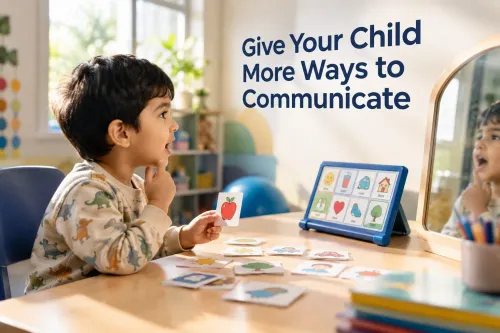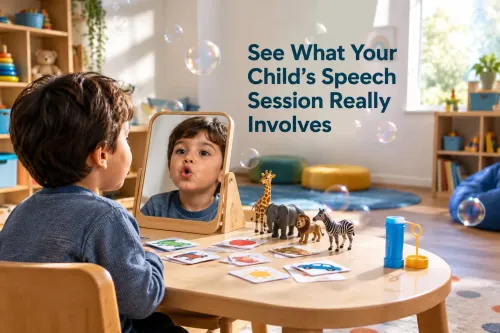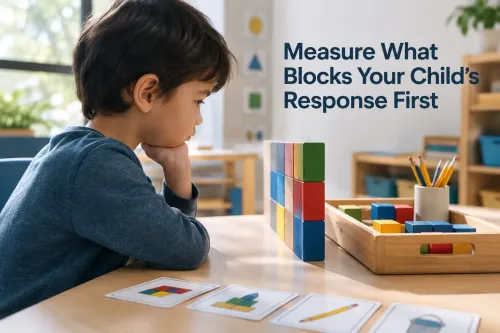

A child may follow instructions, understand familiar words, and communicate through actions while using few or no spoken words. You will learn how receptive and expressive language differ, which signs call for prompt assessment, what therapy can target, and when AAC or a wider developmental team belongs in the plan.
Key takeaways
- Strong understanding supports a speech-language assessment, even without spoken words.
- Assessment checks hearing, communication, motor skills, play, and alternative communication needs.
- Therapy can begin with gestures, signs, pictures, sounds, and communication devices.
- Choose a provider who sets measurable goals and includes parents in daily practice.
Does strong understanding make speech therapy appropriate?
Yes. A child who understands language but does not speak is an appropriate candidate for speech-language assessment and often for speech therapy for children who understand but do not speak. Receptive language means understanding words, questions, and instructions. Expressive language means communicating through speech, gestures, signs, pictures, or devices.
Strong comprehension can show that receptive language is ahead of expressive language, but it cannot predict when speech will emerge or identify the cause. “Understands but does not speak” describes a communication profile, not a diagnosis.
The assessment should look beyond word count and examine:
- Gestures, pointing, pretend play, imitation, and social communication
- Functional communication, including making choices, requesting help, refusing, and gaining attention
- Speech-motor planning, oral-motor skills, and the child’s ability to produce sounds or sequence movements
Possible explanations include:
- Late language emergence
- A motor-speech difficulty
- Autism-related communication differences
- Intellectual disability
- Another developmental condition
At 24 months, fewer than 50 words or no two-word combinations is a valid reason to seek evaluation rather than wait. Assessment is still appropriate when a child points, plays imaginatively, engages socially, and appears to understand well; these strengths do not make therapy unnecessary.
Why might a child understand but remain non-speaking?
Understanding language does not identify the cause of absent speech. An isolated expressive-language delay affects spoken output while comprehension is relatively stronger. Hearing loss can limit access to speech sounds, even when the child responds to familiar everyday noises.
Childhood apraxia of speech is a speech-motor planning problem, not simply late talking. Signs can include inconsistent sound errors, difficulty sequencing sounds, disrupted prosody, or visible groping movements; lack of speech alone cannot establish apraxia. Dysarthria involves weakness, poor coordination, or abnormal muscle control affecting speech.
Oral-motor difficulty may affect chewing, swallowing, facial movements, or speech production. Autism, intellectual disability, selective mutism, and limited opportunities to communicate are different possibilities requiring different assessments and support.
Arrange hearing testing even if your child appears to hear normally. Mild, fluctuating, or frequency-specific hearing loss can affect speech and language without making a child seem generally deaf. A bilingual or multilingual home does not cause a disorder; assessment must consider every language the child uses.
Seek prompt developmental assessment if you notice:
- Loss of words or social communication
- Poor response to sound or name
- Difficulty following familiar instructions
- No pointing or showing
- Very limited nonverbal communication
- Choking, coughing, or feeding difficulty
Speech therapy for non speaking children can begin alongside evaluation for autism or another developmental condition.
What happens during the first assessment?
Expect the first visit to begin with a developmental and medical history. The clinician asks about pregnancy and birth, hearing, feeding, regression, languages used at home, childcare, and how your child communicates at home. If hearing results are absent, outdated, or concerning, the clinician arranges a hearing test or audiology referral.
Play provides much of the evaluation. The clinician observes eye gaze, gestures, imitation, turn-taking, pointing, showing, responses to familiar people, and responses to instructions. Comprehension tasks check whether your child understands objects, actions, choices, questions, and simple directions. Expressive communication includes speech sounds, vocalisations, gestures, signs, pictures, and behaviour—not only spoken words.
An oral-motor examination is used when feeding, drooling, chewing, facial movement, or speech production raises concern. If your child can participate, a speech-motor assessment examines sound consistency, sound sequencing, syllables, prosody, and effort. The result should identify functional goals and recommend additional support when speech therapy alone cannot meet the child’s needs:
- AAC, such as signs, pictures, communication books, or a speech-generating device
- Developmental or medical evaluation
- Occupational therapy
- Educational or special-education support
- Behavioural support
The clinician should explain why each recommendation applies and how professionals will coordinate care.
What does therapy look like before spoken words appear?
Before spoken words appear, speech therapy for non speaking children focuses on making communication work, not drilling pronunciation. Child speech therapy communication support can build imitation, turn-taking, sound play, pointing, gestures, signs, picture exchange, visual choices, and functional requesting.
Useful early goals include:
- Asking for a preferred item
- Refusing or indicating “no”
- Choosing between two activities
- Commenting on an object or event
- Answering a familiar question
- Gaining another person’s attention
- Joining meals, dressing, play, or childcare routines
- Communicating pain, fear, or safety needs
AAC can begin before speech develops and does not mean abandoning speech goals. Current evidence does not support the claim that AAC prevents speech.
| AAC option | What it supports | When it fits |
|---|---|---|
| Gestures or signs | Quick requests, refusal, attention, and routines | When the child can copy or use body movements |
| Picture board | Choices, requesting, commenting, and answering | When visual symbols are easier than speech |
| Communication book | More words and activities across settings | When several pages or categories are needed |
| Speech-generating device | Voice output for broader communication | When a robust system is appropriate after assessment |
Communication partners need to model the system during meals, dressing, play, childcare, and community activities. Do not store a device for therapy sessions only. Coaching teaches caregivers to wait for a response, offer meaningful choices, respond to every attempt, expand gestures or sounds, and adapt activities to the child’s interests and sensory needs.
Oral-motor work belongs in the plan only when an examination identifies a relevant motor or feeding concern.
How should you choose a therapy plan and provider?
Choose a provider by what the assessment can explain and what the plan can measure, not by the number of therapy sessions offered. A strong plan includes communication goals for daily life, not only pronunciation practice.
| Check | Ask the provider | Why it matters |
|---|---|---|
| Formal assessment | Do you complete a speech-language assessment covering receptive, expressive, social, and functional communication? | Word counts alone can miss the child’s real needs. |
| Hearing | Will you arrange audiology referral if hearing results are missing, outdated, or concerning? | Mild or fluctuating hearing loss can affect speech and language. |
| AAC | Do you support signs, pictures, communication books, or speech-generating devices? | A child needs a reliable way to communicate before speech develops. |
| Caregiver coaching | How will we practise goals during meals, play, dressing, childcare, and outings? | Communication improves through repeated daily opportunities. |
| Measurable goals | How will you track requests, choices, refusals, comments, and help-seeking across home, school, and childcare? | You can see whether skills generalise beyond the clinic. |
Ask how the clinician will distinguish language delay from motor-speech difficulty by examining sound consistency, sequencing, imitation, effort, and prosody. Ask who coordinates care and what happens if your child loses skills, develops choking or feeding concerns, or needs a developmental evaluation.
A child may need speech work alongside sign language, visual supports, occupational therapy, special education, developmental therapy, or behavioural support. Assessment should determine that combination, not a fixed package. For families searching “speech therapy for late talking children pune,” location is only one filter.
SAVI CHILD DEVELOPMENT AND RESEARCH CENTRE PVT LTD is worth considering in Wanoworie when its assessment-led, multidisciplinary services include child speech therapy communication support for non-speaking children.
Related service
Speech Therapy At Savi ChildCare, our specialized Speech Therapy services help children develop effective communication and language skills in a supportive,... View service → |
Frequently asked questions
Is speech therapy suitable for a child who understands but does not speak?
Yes. Strong receptive language makes a child appropriate for speech-language assessment and often for speech therapy. The therapist will identify how the child communicates and what is blocking spoken expression.
Why might a child understand language but remain non-speaking?
Possible factors include hearing loss, speech-motor difficulties, developmental language differences, autism, oral-motor challenges, or limited opportunities to communicate. An assessment is needed to identify the cause.
What happens during the first speech therapy assessment?
The clinician reviews development and communication history, checks hearing information, observes play and responses, and assesses understanding, gestures, sounds, speech movements, and alternative communication needs.
What does speech therapy involve before spoken words appear?
Therapy may build intentional communication through eye gaze, gestures, signs, pictures, sounds, turn-taking, and communication devices while supporting later speech development.