
A child may struggle with dressing, eating, handwriting, grooming, play or classroom routines for several different reasons, so the right therapy depends on the task rather than a label alone. By the end, you will be able to match everyday difficulties to occupational therapy options, compare related services and ask for a plan with measurable outcomes.
Key takeaways
- Start with the daily task your child finds difficult, not a diagnostic label.
- Ask for occupational therapy support when sensory needs disrupt eating, dressing, sleep, or participation.
- Combine occupational therapy with speech, physical therapy, or special education when needs overlap.
- Judge progress by greater independence in real routines at home, school, and play.
Match Occupational Therapy to the Everyday Task
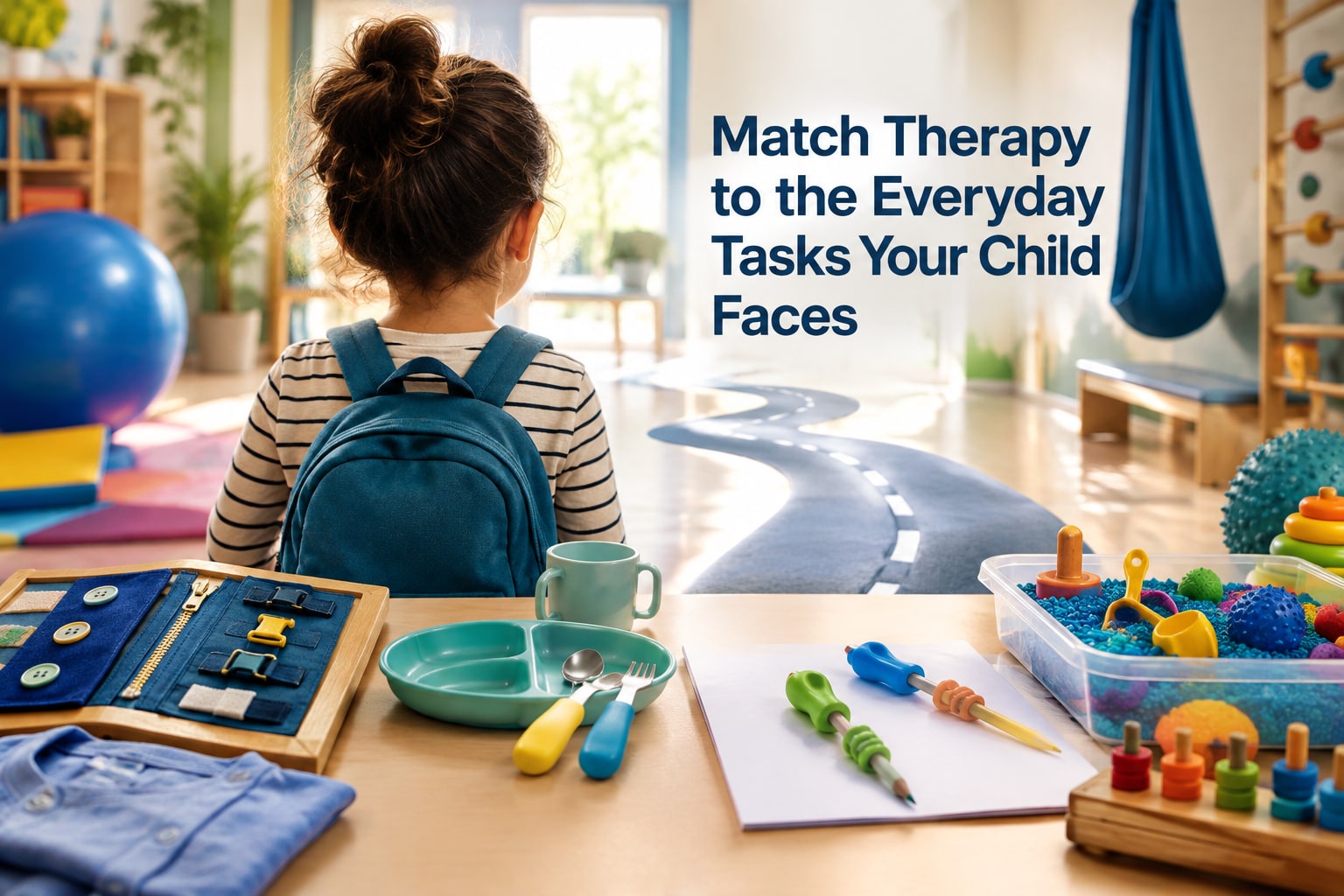
The best occupational therapy options for children start with a task that is failing, not a label or an isolated weakness. Explore an assessment when your child needs unusual help with dressing, toileting, eating, handwriting, play, sleep, movement, attention or joining classroom routines.
| Everyday problem | What occupational therapy may target | Useful sign to discuss |
|---|---|---|
| Dressing or toileting | Fasteners, body awareness, sequencing, balance and adapted clothing or bathroom equipment | The child cannot manage a step expected for their age, even after repeated practice |
| Eating | Sitting position, utensil use, food texture tolerance and mealtime routines | Meals involve distress, prolonged feeding or a very narrow range of foods |
| Handwriting or schoolwork | Pencil control, posture, visual-motor skills, task steps and desk setup | Written work is far slower, harder to read or more tiring than spoken work |
| Play or motor coordination | Actual practice with cutting, building, catching, cycling or playground movements | The child avoids games, falls frequently or cannot copy peers’ actions |
| Sleep, attention or classroom participation | Visual routines, sensory adjustments, transitions, regulation and environmental changes | Noise, clothing, movement or task changes repeatedly prevent participation |
Ask the therapist to connect observed motor, sensory, attention or emotional factors to one concrete outcome, such as fastening a coat or completing a worksheet. Environmental changes count as treatment: a different pencil grip, seating position, visual routine or task sequence can increase independence.
More weekly sessions are not automatically better; the plan should allow useful practice in ordinary routines and show progress outside the clinic.
What Happens in Therapy, Including Support for Sensory Needs
A session starts with an observation, not a worksheet. The occupational therapist watches how the child approaches a real task, identifies where it breaks down, and agrees on a functional target such as fastening a shirt, staying at the table, or joining classroom work.
Goals guide the session length and frequency; more visits do not help if practice never transfers to home or school.
A practical session may include:
- Breaking the task into steps and changing one demand at a time.
- Practising through play, such as climbing, building, drawing, or using tools to develop coordination.
- Adding movement or body-based activities when the child struggles to organise sensory input.
- Trying visual schedules, adapted pencils, special seating, clothing fasteners, utensils, or bathroom equipment.
- Coaching caregivers or teachers to repeat the strategy during dressing, meals, homework, or transitions.
Occupational therapy for sensory needs begins with the activity affected, not a sensory label alone. Ask whether noise stops the child from eating, sleeping, dressing, or entering class.
The therapist then tests a practical change: reducing noise, offering a predictable movement break, adjusting lighting, simplifying a task, or teaching the child how to request a pause. The plan may address sensory seeking, sensory avoiding, over-responsivity, under-responsivity, or difficulty organising input.
Track the result by participation: Did the child finish the meal, tolerate the shirt, or remain in class longer? Caregivers practise the strategy between visits, including in natural settings such as home or childcare.
Compare Occupational Therapy with Other Child Services
Choose the service by the daily outcome you want, not by the label on the programme. The types of occupational therapy for children range from clinic sessions and caregiver coaching to school-based or early-intervention support, but all connect skills to participation in real routines.
| Option | Main focus | How it differs from occupational therapy |
|---|---|---|
| Sensory integration | Ayres Sensory Integration® uses active, play-based sensory-motor challenges matched to the child | Generic sensory activities, weighted items and movement breaks are not automatically this approach; OT may use sensory strategies to support dressing, attention or play |
| ABA | Builds communication, self-care or learning skills through behavioural teaching and reinforcement | It targets observable behaviour systematically; OT analyses motor, sensory and task demands |
| Speech therapy | Speech, language, social communication and swallowing | OT may support utensil use, posture or mealtime routines; a speech-language pathologist assesses choking, aspiration or swallowing impairment |
| Physiotherapy | Strength, balance, mobility, gait and physical function | OT focuses more on hand use, self-care, play, classroom access and adapting tasks or equipment |
| Special education | Curriculum access, academic instruction and learning supports | School-based OT helps the child participate in education; it does not replace teaching |
| Feeding intervention | Eating skills, food acceptance and oral-motor or swallowing needs | OT may address seating, self-feeding and sensory tolerance, while swallowing concerns need medical and speech-language assessment |
A combined plan is common. Ask each provider to name the specific participation goal, who owns it and how progress will be measured across home, school and community routines.
Choose a Combination When Needs Overlap
Choose child occupational therapy choices by the participation problem that is limiting the child most, not by the number of diagnoses. Start with one shared outcome, such as eating safely at family meals, dressing for school, or completing written work, then assign each professional a distinct role.
| Overlapping need | Useful combination | Decision point |
|---|---|---|
| Motor plus sensory | Occupational therapy with movement, regulation and environmental adaptations | Check whether coordination or sensory input is stopping dressing, play or classroom access |
| Feeding plus motor | Occupational therapy with postural, utensil and self-feeding practice | Seek medical and swallowing assessment for choking, coughing, aspiration or poor weight gain |
| Feeding plus communication | Occupational therapy with a speech-language pathologist | Separate food tolerance and self-feeding from suspected swallowing or communication difficulties |
| Communication plus daily living | Occupational therapy with speech therapy or ABA | Keep the target functional: requesting help, following routines or completing toileting |
| School plus motor or attention | School-based OT with clinic or home support | School OT addresses educational access; clinic OT can address wider home, play and self-care goals |
Ask each provider to share the same functional goal, measures and home strategy. Duplicate handwriting drills or sensory activities waste time when the child needs keyboarding, classroom adaptations, quieter seating or direct writing practice.
SAVI CHILD DEVELOPMENT AND RESEARCH CENTRE PVT LTD can be asked to explain how occupational therapy, ABA or oral-placement work will be coordinated rather than delivered as separate, disconnected programmes.
Sensory work should earn its place by improving eating, sleep, dressing or participation; it should not aim to eliminate autism or treat a sensory profile alone.
Related services
Occupational Therapy For Children In Pune Occupational Therapy For Children In Pune Occupational therapy plays a crucial role in helping children with special needs, particularly those diagnosed with autism, achieve greater... View service → |
Sensory Integration The early years of childhood are a crucial period for learning and development. View service → |
Judge the Plan by Participation and Progress
Commit to ongoing therapy only when the assessment connects a specific barrier to a daily activity. “Noise sensitivity” is not enough; the question is whether noise prevents eating, sleeping, dressing, joining class or playing.
The clinician should observe the child doing the task, identify motor, sensory, attention or emotional factors, note strengths, and record a baseline such as prompts needed, time taken or steps completed.
Ask for these five elements before agreeing to a long block of sessions:
- A functional goal, such as putting on a shirt with one verbal prompt, rather than improving “sensory processing” in isolation.
- A written plan naming the treatment setting, people involved and any environmental changes, such as a visual routine, adapted fastener, seating support or quieter workspace.
- A home programme that states exactly what you will do, how often, for how long and what to do if the child becomes distressed. It should fit an existing routine, not require hours of extra practice.
- A way to measure progress using observable results: fewer prompts, longer participation, safer utensil use, faster dressing or improved classroom access.
- A review date and a decision rule: continue, change the approach, reduce support or stop if the target is met or progress is absent.
At review, bring notes from home and school. If feeding includes coughing, choking, aspiration concerns or poor weight gain, seek medical and swallowing assessment rather than relying on occupational therapy alone.
Frequently asked questions
How do I match occupational therapy to my child’s everyday needs?
Start with the task that is failing, such as dressing, toileting, eating, handwriting, play, sleep, movement, attention, or classroom participation. The therapist assesses the task and builds goals around greater independence.
What does occupational therapy include for sensory needs?
Therapy may examine how sensory input affects movement, attention, eating, sleep, play, and daily routines. The therapist then uses activities and practical changes that support participation in those routines.
How does occupational therapy compare with other child services?
Occupational therapy focuses on daily activities, fine-motor skills, sensory processing, self-care, and participation. Speech therapy addresses communication and feeding skills, physical therapy focuses on gross motor function, and special education supports learning and classroom access.
When should a child use a combination of services?
Choose a coordinated plan when difficulties cross areas, such as communication, movement, sensory regulation, learning, and self-care. Each professional should connect goals to the same routines rather than work in isolation.
How can I judge whether occupational therapy is working?
Track changes in participation and independence: completing more dressing steps, tolerating meals, using classroom tools, joining play, sleeping more consistently, or needing less adult help.