
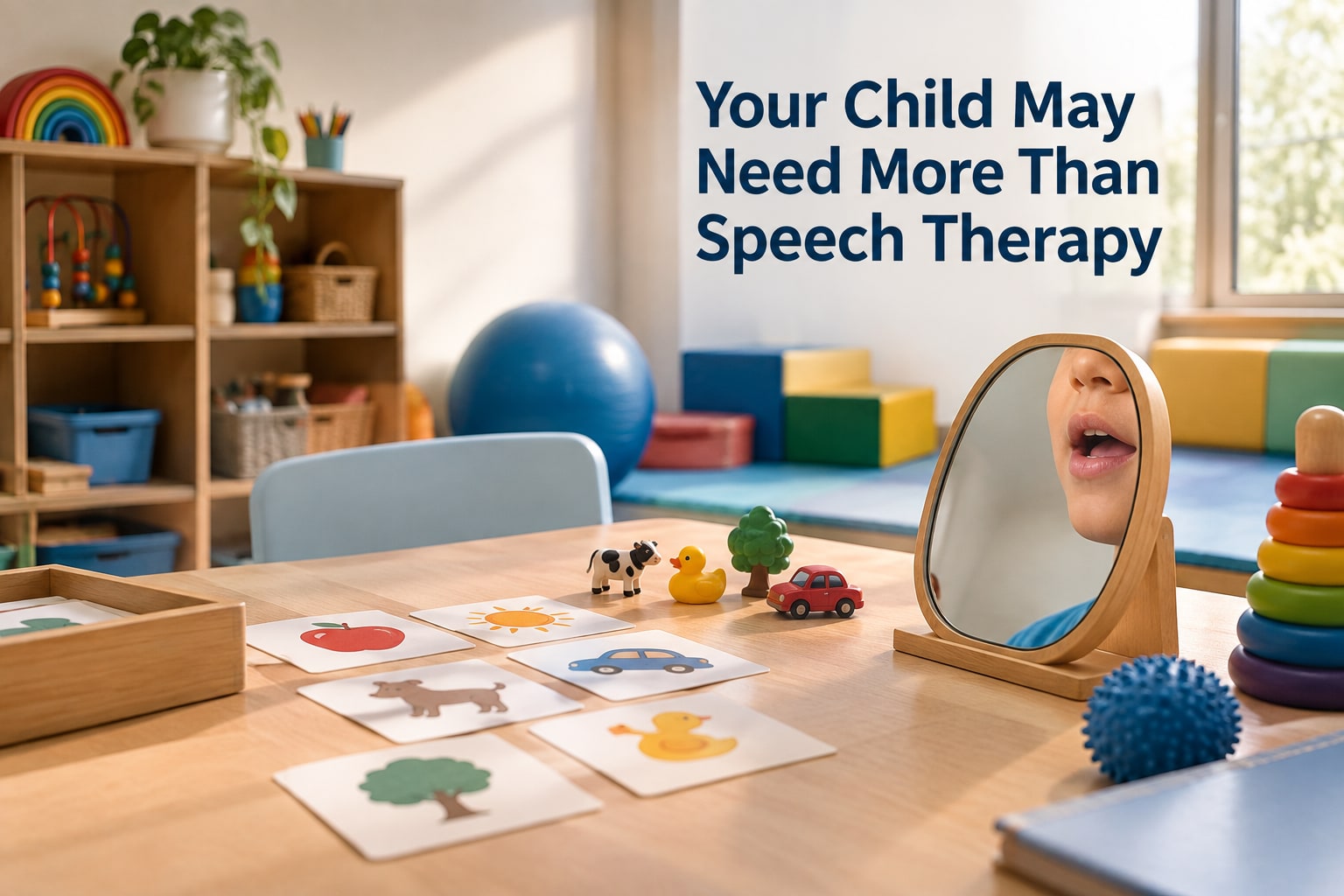
A child who speaks late, speaks unclearly, repeats scripts, or cannot explain needs may require more than one kind of support. By comparing speech-language therapy with AAC, occupational therapy, ABA, special education, oral-motor work, and caregiver coaching, you can identify the right starting assessment and the outcomes worth tracking.
Key takeaways
- Speech therapy covers speech, language, fluency, voice, social communication, and swallowing.
- Seek assessment when communication difficulties affect understanding, expression, participation, or daily routines.
- Match therapy goals to the child’s profile instead of choosing services by label alone.
- Combine speech therapy with AAC, occupational therapy, special education, or parent coaching when needed.
What does speech therapy address compared with other communication services?
Speech-language therapy addresses far more than pronunciation. A speech-language pathologist assesses speech sound production, receptive and expressive language, vocabulary, sentence formation, comprehension, fluency, voice, social or pragmatic communication, and feeding or swallowing when appropriately trained.
Speech means producing sounds. Language means understanding and using words, grammar, and sentences. Communication includes speech, gestures, signs, pictures, writing, and devices; social communication includes turn-taking, joint attention, sharing topics, and interpreting another person’s message. “Communication therapy” is often an overlapping service label, not a separate Pune category.
For speech therapy benefits compared with other communication support in Pune, compare the problem each service is designed to address:
- Occupational therapy: sensory regulation, fine-motor skills, device access, feeding, and participation in routines—not language assessment.
- Sensory integration: responses to sensory input and regulation—not a substitute for speech-language evaluation.
- ABA: structured learning, behaviour, social interaction, and functional communication.
- Special education: classroom teaching, literacy, curriculum access, and learning participation.
- Oral-motor therapy: movement and coordination for speech or feeding, only when a qualified professional identifies that need.
- Informal developmental support and caregiver coaching: communication opportunities during play and routines, but not diagnostic assessment.
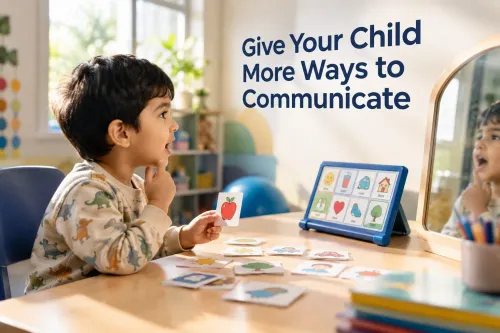
- AAC: signs, picture boards, communication books, or speech-generating devices for children who cannot reliably use speech, including children who speak some words.
Therefore, speech therapy or communication therapy in Pune is not always an either-or choice. AAC can complement speech therapy, while occupational therapy, education, or structured social-communication support can address barriers outside the speech-language clinician’s scope.
When should you seek a speech-language assessment, and what will it involve?
Seek an assessment rather than waiting if your child understands less than expected, uses very few words or gestures, is hard for familiar or unfamiliar listeners to understand, stops gaining communication skills, or cannot follow everyday directions.
Evaluation also fits a child who rarely requests or refuses clearly, struggles to answer questions, cannot take simple conversational turns, repeats scripts, relies on adults to interpret needs, or becomes distressed while communicating.
1. The clinician begins with a caregiver interview about developmental history, languages used at home, hearing concerns, medical history, feeding, play, school participation, and previous services.
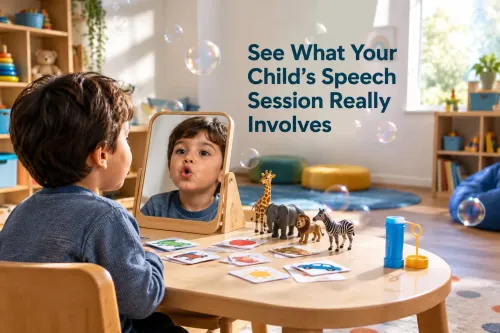
2. The assessment includes observation of spontaneous communication, interaction, play, and daily routines. The clinician reviews or arranges a hearing check, then uses standardized or informal measures of receptive and expressive language.
3. If speech clarity is a concern, request a speech-sound assessment. The clinician should distinguish unclear sound production from difficulty understanding language, forming sentences, or using communication socially.
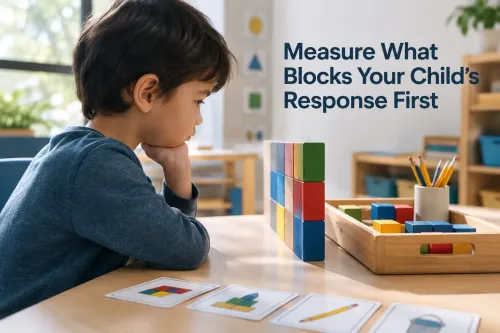
4. The clinician identifies functional priorities, such as following two-step directions, requesting help, communicating pain or refusal, answering questions, and taking turns. Ask how progress will be measured across home and school, not only during sessions.
Families searching “speech therapy for language delays Pune” should ask how Marathi, Hindi, English, or another home language will be assessed. Vocabulary divided across languages is not proof of delay. Request a plan naming baseline skills, practice contexts, communication partners, and review dates.
How do speech therapy benefits differ by communication profile?
The right plan depends on what is limiting communication, not simply how unclear speech sounds. Therapy for an articulation disorder may improve specific sound patterns, intelligibility, and carryover from practice words into conversation; another profile needs a different target.
| Profile | Main therapy priorities |
|---|---|
| Articulation disorder | Specific sound patterns, intelligibility, and use of accurate sounds in conversation |
| Language delay or developmental language disorder | Comprehension, vocabulary, grammar, sentence formation, and communication across play, home, and school; normal hearing does not rule it out |
| Childhood apraxia of speech | Inconsistent errors, sound sequencing, prosody, and motor planning rather than generic pronunciation drills |
| Stuttering | Fluency assessment, communication confidence, and strategies suited to the child and family; pressure to speak faster can worsen the experience |
| Autism-related communication differences | Joint attention, reciprocal interaction, imitation, play, gestures, AAC, and functional requests—not only clearer speech |
| Hearing-related delay | Hearing evaluation first, followed when needed by hearing technology and auditory-verbal or listening-and-spoken-language support alongside speech-language therapy |
| Developmental disability | Combined speech, language, social-communication, and AAC goals linked to independence |
A child who understands language but does not speak needs a different plan from one who neither follows directions nor expresses ideas. Repeated scripts, few gestures, or difficulty sustaining conversation call for social-communication assessment alongside expressive-language testing.
Choose goals that match daily participation: requesting help, refusing, answering, taking turns, communicating pain, and being understood across people and settings.
When should speech therapy be combined with broader communication support?
Choose a combined plan when one service cannot remove the barrier to participation. Add AAC when speech is unreliable or too slow for your child to communicate needs. AAC does not require a child to be completely non-speaking, and current clinical evidence does not support the claim that it stops speech development.
Add support according to the barrier:
- Occupational therapy when sensory regulation, fine-motor control, seating, feeding, or access to a communication device interferes with communication.
- ABA or another structured social-communication approach when your child needs systematic teaching for learning, interaction, behaviour, or functional requests.
- Special education when language difficulty affects classroom instructions, literacy, curriculum access, or participation.
- Parent-mediated coaching when caregivers need to create requests, choices, turn-taking, and communication repairs during meals, dressing, travel, and play. This is more than sending home worksheets.
Early intervention fits children who need help across several developmental domains. For an autistic child, a plan may combine speech-language therapy, AAC, parent coaching, structured social communication, occupational therapy, and educational support.
Compare child communication support options in Pune by outcomes, not session count.
| Support | Use it when | Measure progress by |
|---|---|---|
| Speech-language therapy | Speech or language limits participation | Directions, requests, answers, turns |
| AAC | Speech is unreliable or delayed | Consistent use at home and school |
| Occupational therapy | Regulation, motor skills, feeding, or device access blocks communication | Independent access and participation |
| Special education | Language affects learning | Classroom, literacy, and curriculum access |
Also track pain or refusal, intelligibility with unfamiliar listeners, and communication repairs.
How can you compare communication providers and plans in Pune?
The strongest Pune plan is the one that names who assesses your child, what will be measured, and how communication will work across home, school, and unfamiliar settings. Verify the practitioner’s Rehabilitation Council of India registration, the discipline recorded there, and the languages they can evaluate, rather than relying on “therapist” or an institute’s marketing.
| Option | What to verify | When it fits |
|---|---|---|
| Speech-language therapy | Comprehension, spoken language, speech clarity, fluency, social communication, and AAC needs | Language, speech, or functional communication is the main barrier |
| Occupational therapy | Sensory regulation, fine-motor control, seating, feeding, or access to a communication device | Physical or sensory barriers interfere with communication |
| AAC-supported plan | Signs, pictures, communication books, or a speech-generating device are taught and used across settings | Speech is unreliable, unclear, or too slow for immediate needs |
| Multidisciplinary plan | Each professional’s goals, review dates, and method for sharing progress | Communication difficulties occur with developmental, sensory, motor, feeding, or learning needs |
Request a written baseline and measurable review points. Useful measures include:
- Percentage of two-step directions followed
- Number of spontaneous requests
- Intelligibility with an unfamiliar listener
- Successful conversational turns
- Independent communication of pain, help, and refusal
- Consistent AAC use at home and school
Ask whether hearing findings, school demands, feeding, sensory needs, caregiver routines, and all home languages have been considered. SAVI CHILD DEVELOPMENT AND RESEARCH CENTRE PVT LTD in Wanoworie can be assessed against these questions when you compare stand-alone speech-language therapy with broader developmental support.
The useful choice is the plan that improves understanding, expression, participation, and communication—not simply the one offering the most weekly sessions.
Related services
Speech Therapy At Savi ChildCare, our specialized Speech Therapy services help children develop effective communication and language skills in a supportive,... View service → |
Occupational Therapy For Children In Pune Occupational Therapy For Children In Pune Occupational therapy plays a crucial role in helping children with special needs, particularly those diagnosed with autism, achieve greater... View service → |
Frequently asked questions
What does speech therapy address compared with other communication services?
Speech-language therapy can address speech sounds, receptive and expressive language, vocabulary, sentence formation, comprehension, fluency, voice, social communication, and feeding or swallowing. Other services may focus on augmentative and alternative communication, education, sensory regulation, or parent support.
When should you seek a speech-language assessment, and what will it involve?
Seek an assessment when a child struggles to understand, express needs, speak clearly, use language socially, or participate in everyday routines. The assessment can review speech, language, fluency, voice, communication at home and school, and feeding or swallowing when relevant.
How do speech therapy benefits differ by communication profile?
A child with speech-sound difficulties needs different goals from a child with a language delay, stammering, autism-related social communication needs, voice concerns, or swallowing difficulties. The therapist should link goals and progress measures to the child’s specific profile.
When should speech therapy be combined with broader communication support?
Combine services when communication difficulties overlap with learning, sensory, motor, behavioural, social, or daily-living needs. Support can include AAC, occupational therapy, special education, developmental care, and coaching for caregivers.
How can you compare communication providers and plans in Pune?
Compare the clinician’s qualifications, assessment process, therapy goals, session format, caregiver involvement, progress reviews, coordination with school and other therapists, travel demands, and how the plan handles AAC or referrals when required.
Related services
Sensory Integration The early years of childhood are a crucial period for learning and development. View service → |
Early Intervention . Early Intervention Centre Services Can Make a Meaningful Difference The early years of childhood are a crucial period for learning and development. View service → |
Oral Placement Therapy (OPT) focuses on improving the awareness, strength, coordination, and movement of the muscles involved in speech, feeding, and oral motor... View service → |
ABA Therapy Applied Behavior Analysis (ABA) Therapy is a personalized approach that helps children develop important communication, social, learning, and... View service → |