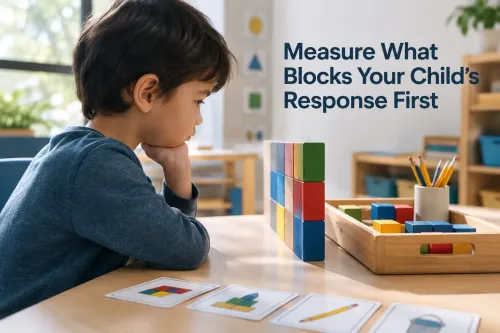

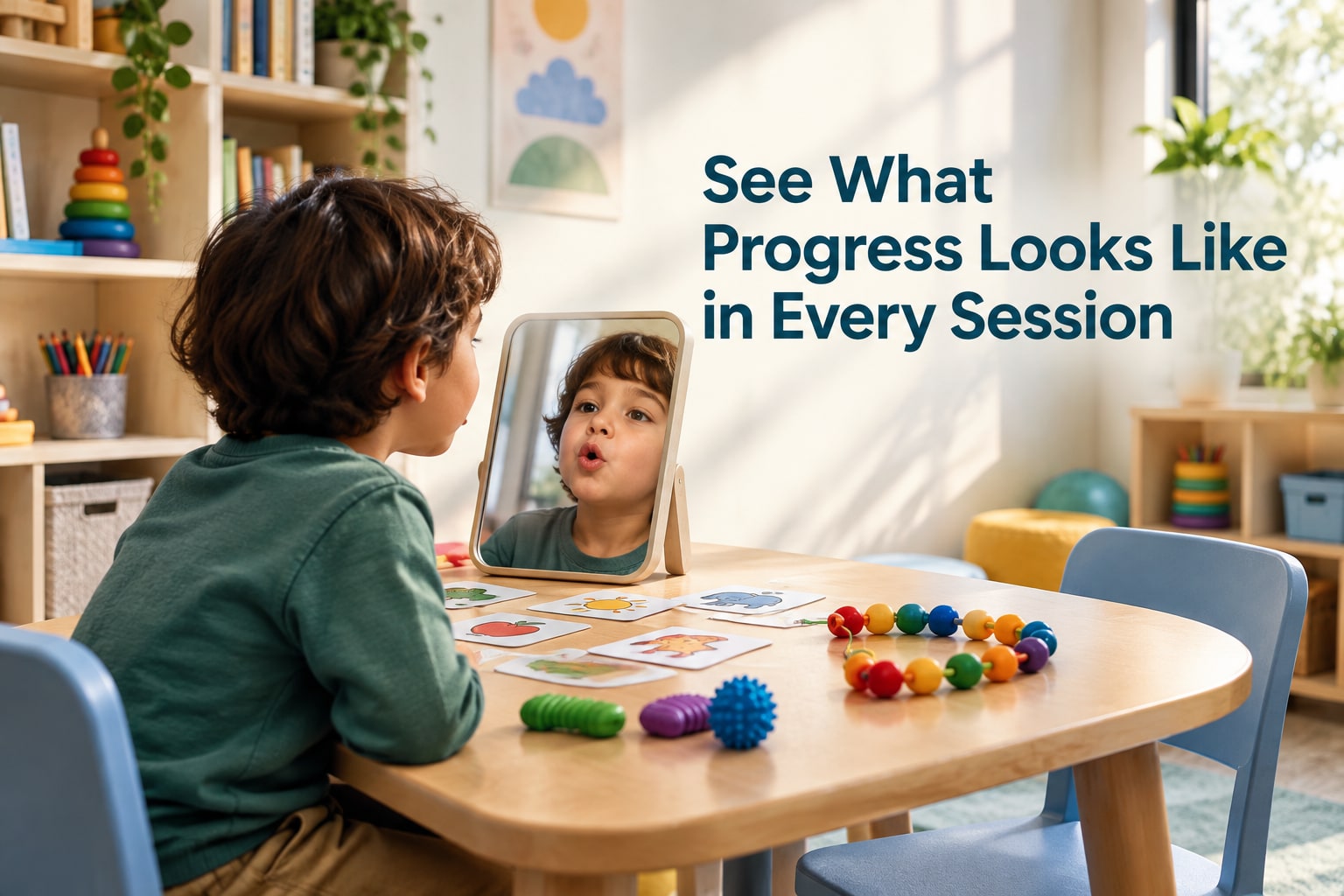
A first appointment usually involves a detailed history, observation, hearing considerations, and goal setting before regular practice begins. By understanding each stage—from arrival and play-based assessment to parent coaching and review—you can prepare your child and know what useful progress looks like between visits.
Key takeaways
- Expect assessment, play, conversation, and planning at the first appointment.
- Therapists observe communication, attention, listening, play, and daily interactions.
- Activities change with your child’s age, goals, interests, and response.
- Track progress through functional communication, not only clearer speech sounds.
What happens at the first speech therapy appointment?
The first speech therapy appointment for children Pune families attend usually focuses on assessment and planning, not immediate speech drills. The therapist introduces themselves, helps the child settle through play or a familiar activity, and explains what will happen.
The case history covers pregnancy and birth, medical conditions, hearing, languages used at home, developmental milestones, school concerns, and situations where communication becomes difficult. Bring previous reports, hearing records, school observations, and a list of languages used regularly.
The clinician observes how the child enters, responds to a new adult, plays, communicates needs, and separates from a caregiver. They discuss understanding spoken language, gestures, words, sentences, speech sounds, fluency, voice, feeding, and social interaction.
| First appointment | Follow-up appointment |
|---|---|
| Assessment and case history take more time | Less time goes to background information |
| The therapist identifies strengths, concerns, and possible referrals | The therapist practises selected goals |
| Hearing history is reviewed and audiological testing may be recommended | Responses and progress are measured |
| A therapy plan and home priorities are discussed | Activities and goals are adjusted |
Ask about hearing even if your child appears to hear normally. Mild or fluctuating hearing loss can affect speech and language development, so formal audiological testing may be appropriate. A follow-up visit usually applies the plan through practice, measurement, and feedback.
What does the therapist observe from arrival to departure?
The therapist starts observing from the doorway: how your child enters, greets a new adult, separates from you, and communicates a need. After settling, the clinician may use free play or conversation instead of a formal test. During a child speech therapy session in Pune, a relaxed start often reveals more than immediate pronunciation drills.
| Moment | What the therapist observes | What it helps clarify |
|---|---|---|
| Arrival and play | Eye gaze, gestures, imitation, pretend play, turn-taking, topic sharing, and attempts to repair a misunderstanding | Social communication, play, and functional communication |
| Directions | Choosing an object, identifying a picture, or completing one-step and two-step instructions | Understanding of spoken language |
| Talking and storytelling | Vocabulary, grammar, sentence length, answers to questions, and retelling events | Expressive language |
| Speech and conversation | Sounds in single words, phrases, and conversation; fluency and voice during natural speaking | Speech sounds, stuttering, or voice needs |
The clinician may record communication attempts, correct target sounds, successful directions, and the prompts needed. If spoken communication is insufficient, gestures, signs, picture boards, or a speech-generating device can also be assessed; AAC does not prevent speech development.
These findings help separate needs involving comprehension, expressive language, pronunciation, fluency, social communication, voice, feeding, or oral-motor skills. A child can have several goals, and unclear speech does not automatically mean pronunciation practice is the answer. At departure, the therapist explains the findings, remaining uncertainty, further assessment or referral, and the next practical step.
Which activities are used, and how are they adapted?
A session may look like play, but each activity has a communication target. In the speech therapy process Wanowrie families often ask about, the therapist models a word or phrase, pauses for a response, offers two choices, expands “car” to “red car,” and repeats useful language during meaningful play.
- Your child may name pictures, match objects, answer questions, retell a short story, follow one-step or two-step directions, or practise a target sound in words.
- A game may practise taking turns, requesting a preferred toy, repairing a communication breakdown, or completing a play routine.
- A child can practise communication while moving, playing, eating, dressing, or completing another everyday routine instead of sitting at a table.
- Blowing or tongue movements alone are not general pronunciation treatment. Use nonspeech mouth exercises only when the therapist explains their clear connection to a specific speech target.
| Child’s starting point | How the therapist adapts the activity | Possible communication support |
|---|---|---|
| Shy or cautious | Begins with a familiar toy, observation, or caregiver-led routine instead of direct questions | Modelling and pauses |
| Distressed | Reduces demands, restores a predictable activity, and postpones difficult tasks | Gestures, choices, or a break request |
| Inattentive | Uses movement, short turns, visual choices, or a strong interest | Natural repetition in play |
| Non-speaking or minimally verbal | Adds gestures, signs, picture boards, or a speech-generating device | AAC is immediate communication, not a last resort, and does not prevent speech |
| Bilingual or multilingual | Considers every language the child uses | Limited English exposure is not itself a disorder |
What should parents do during and between sessions?
1. Ask whether you should stay in the room. The decision depends on your child, the goal, the clinic’s approach, and whether the therapist needs to observe independent communication. If you stay, participate without supplying every answer.
The therapist may coach you to pause for five seconds, offer two choices, model a slightly longer phrase, acknowledge a gesture, or repeat a target word during play.
2. Practise a small number of functional targets in daily routines. These might include requesting help, following two-step directions, answering “what” questions, or producing a particular sound pattern. Meals, bathing, dressing, travel, play, and story time usually create more useful practice than worksheet drills.
3. Before leaving, ask how many attempts to practise, which prompt to use, and when to stop. Keep brief notes on spontaneous words, communication attempts, successful turns, and situations that caused difficulty. Do not turn every interaction into a test; stop when your child becomes frustrated and report what happened.
4. Bring those observations to review appointments. The therapist can change the activity, cueing method, target, or referral when progress stalls. Goals should also reflect school participation, attention, motor skills, autism, feeding, and broader development. Coordination with an audiologist, pediatrician, developmental specialist, occupational therapist, physiotherapist, psychologist, or special educator may be needed.
How long will therapy continue, and how do you judge progress?
There is no universal number of sessions or fixed weekly frequency. The plan should reflect your child’s age, diagnosis, hearing, developmental profile, ability to practise outside therapy, and response to treatment.
Before starting in Wanoworie or elsewhere in Pune, confirm:
- Session length and appointment frequency
- Review date and cancellation policy
- Whether a caregiver attends, observes, or practises
- Home-practice targets, prompts, and expected time
Knowing what happens in speech therapy for children Pune families consider, ask for functional goals you can observe: requesting a break, using a communication system, following two-step directions, joining a turn-taking game, answering questions, producing a target sound in conversation, or joining classroom routines.
Ask whether the clinician will record percentages, communication attempts, successful turns, or prompting levels.
| Review decision | Evidence to examine | Possible next step |
|---|---|---|
| Continue | The child is improving toward a useful goal | Keep the goal and adjust difficulty |
| Change | Progress has stalled or prompts remain high | Change the target, cue, activity, or referral |
| Stop | The goal is achieved or no longer relevant | Replace it with a current functional goal |
A useful provider explains findings in plain language, separates assessment from treatment, accepts speech, signs, gestures, pictures, or devices, and coordinates referrals when needed. Families can ask SAVI CHILD DEVELOPMENT AND RESEARCH CENTRE PVT LTD how it documents progress and communicates review decisions.
Judge the plan by functional change, not worksheets, mouth exercises, or activities completed in one appointment.
Related service
Speech Therapy At Savi ChildCare, our specialized Speech Therapy services help children develop effective communication and language skills in a supportive,... View service → |
Frequently asked questions
What happens at the first speech therapy appointment for children?
The therapist introduces themselves, helps your child settle, observes communication, and discusses assessment findings and therapy goals.
What does a speech therapist observe during a session?
They observe how your child listens, understands language, uses sounds or words, plays, takes turns, responds to people, and communicates needs.
Which activities are used in child speech therapy?
Activities can include play, picture cards, books, songs, turn-taking games, sound practice, and everyday communication tasks adapted to your child.
What should parents do during and between speech therapy sessions?
Join when invited, model simple language, respond to communication attempts, practise agreed activities, and share changes with the therapist.
How long will speech therapy continue, and how is progress judged?
Duration depends on the child’s needs and goals. Progress is judged through functional communication, participation, new skills, and regular review of targets.